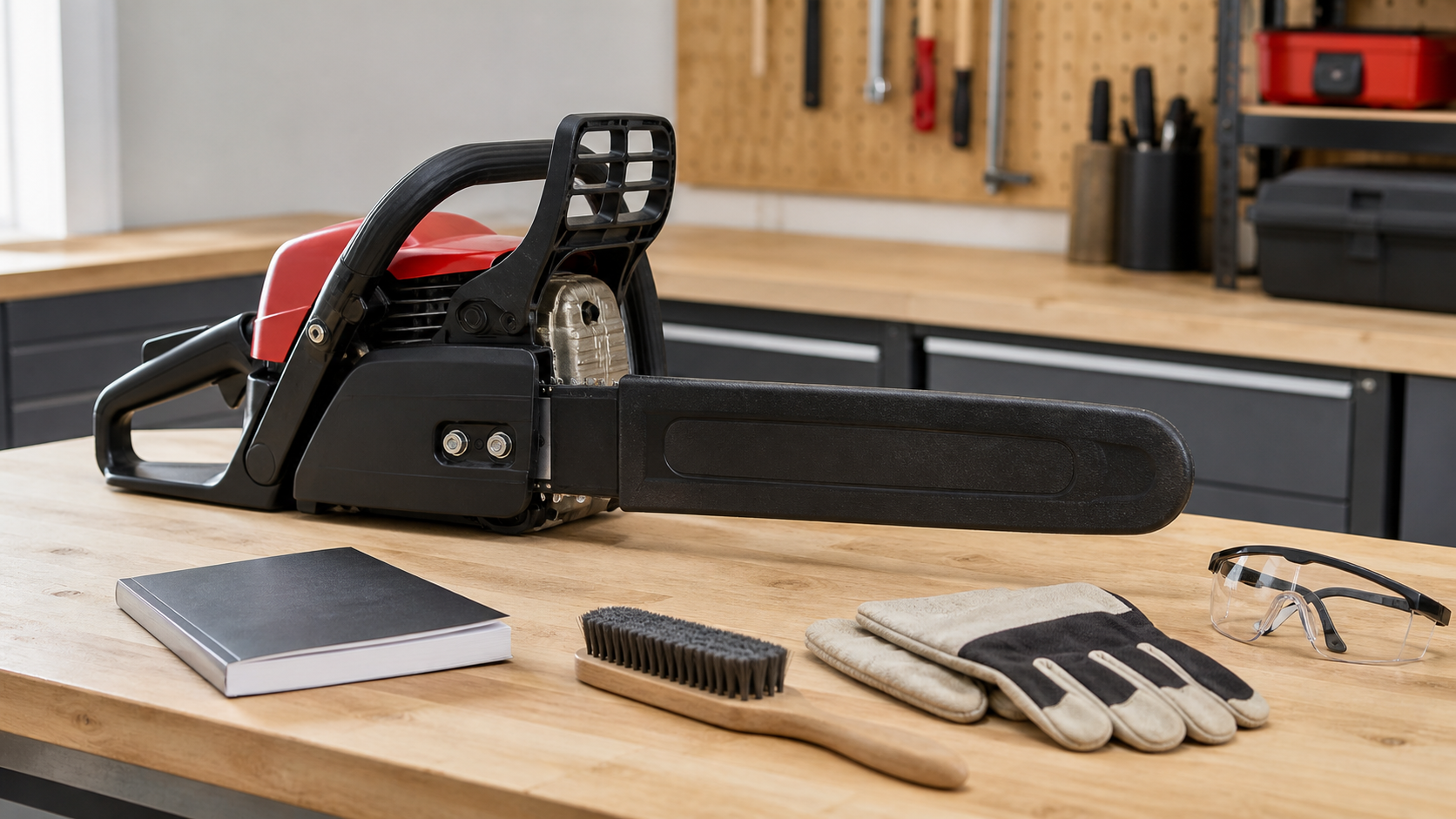
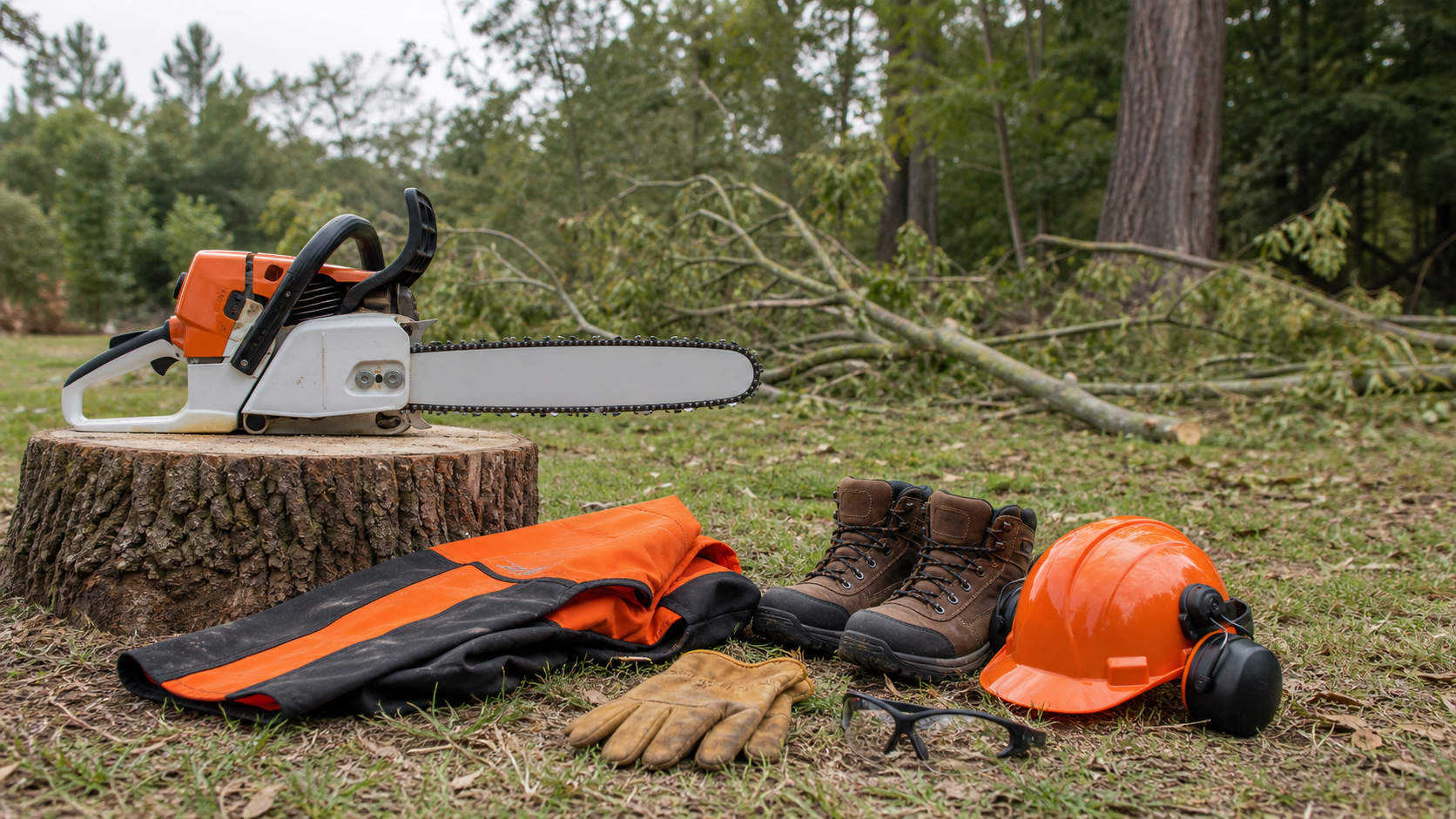
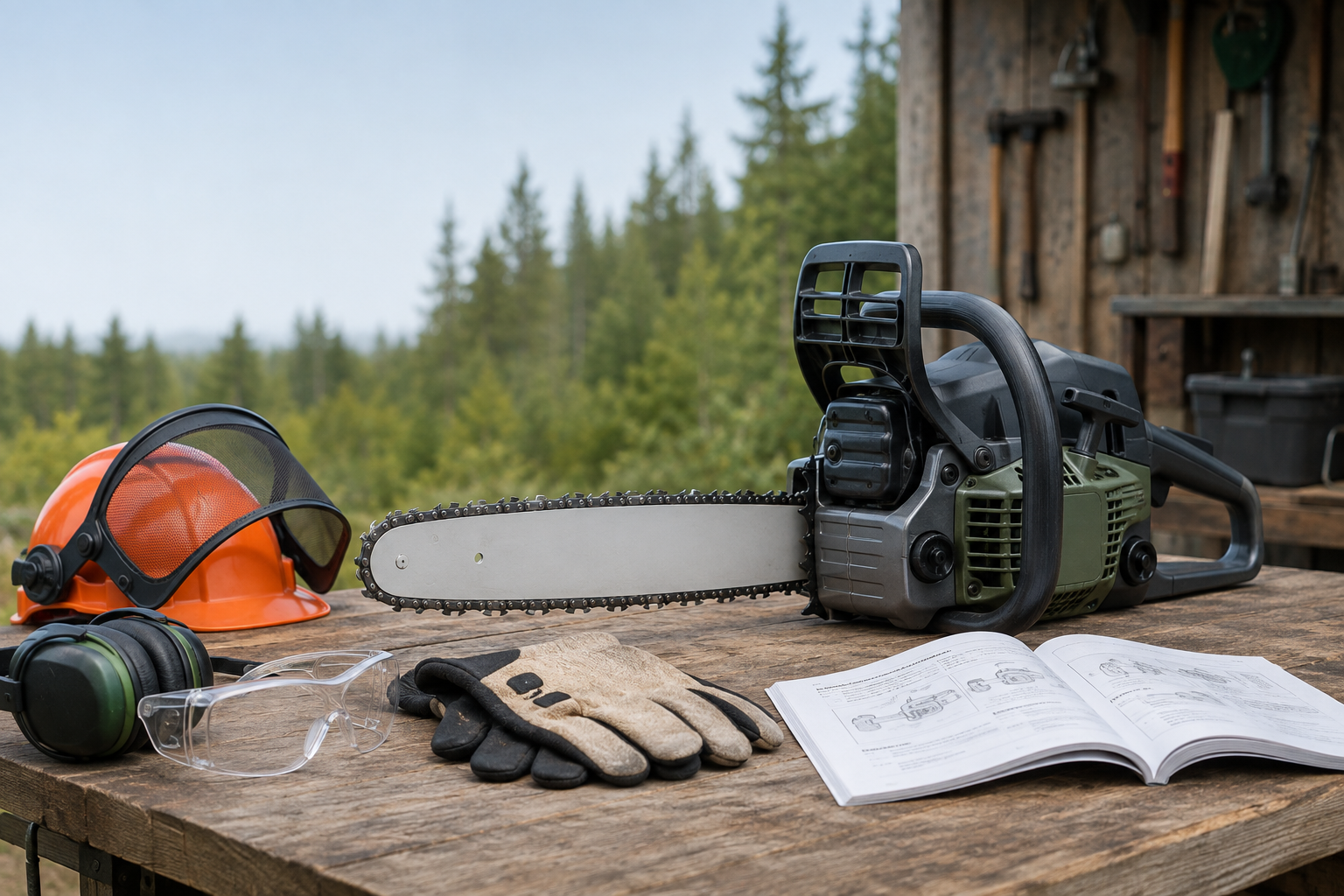
For ground-level firewood cutting, wear serviceable head, eye or face, hearing, hand, leg, and foot protection required by the saw manual, the job, and local rules before starting. Then check the wood, work area, and saw: PPE can reduce the severity of an injury, but it cannot make overhead, tensioned, unstable, or utility-involved wood acceptable to cut.
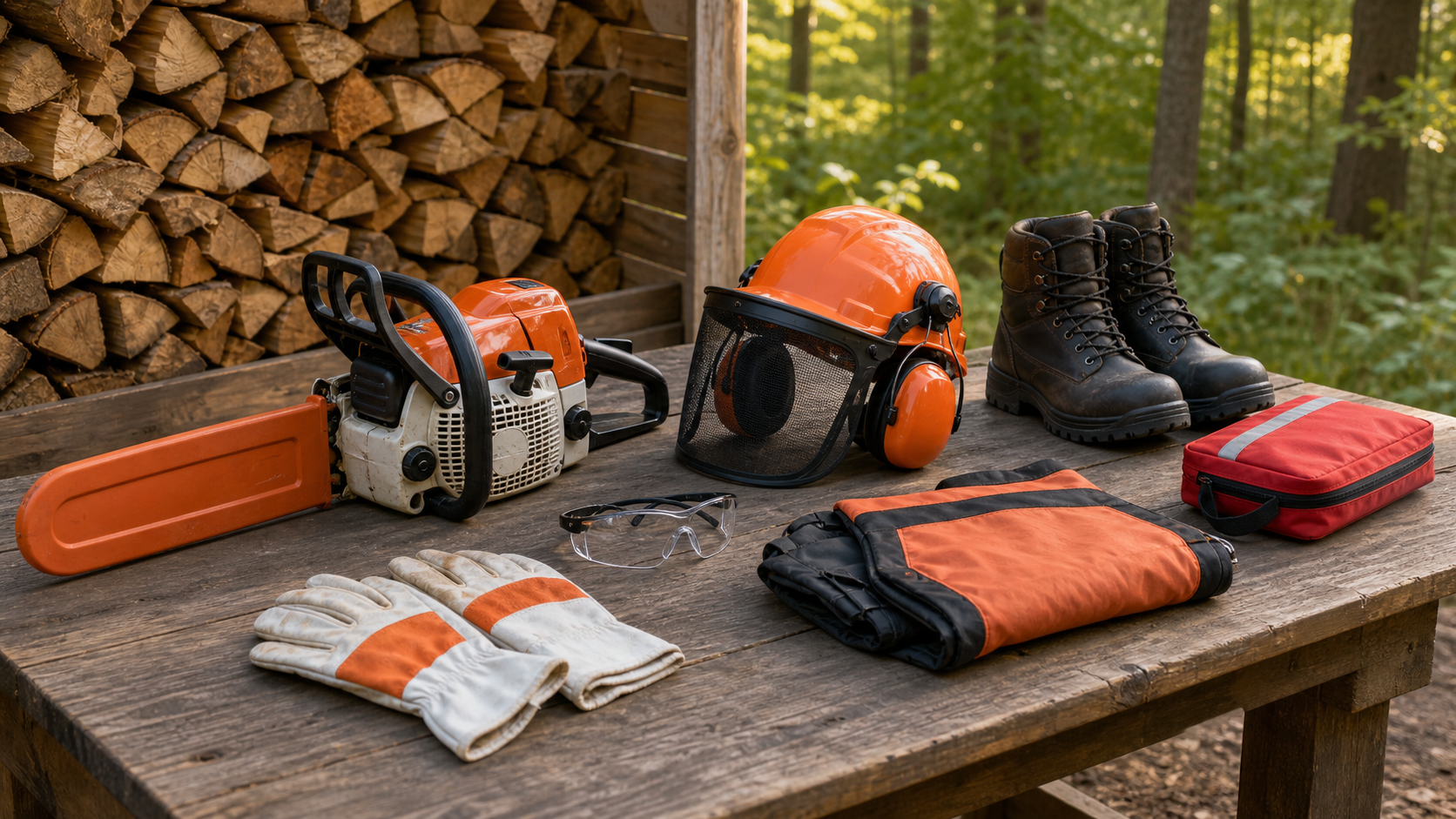
This checklist is for an occasional operator preparing to buck stable, fully downed, separated wood from firm ground. It is not a felling guide, a storm-damage procedure, or a substitute for training and the exact operator’s manual.
Use two gates before the saw starts
Do not treat PPE as a shopping list that automatically clears the job. The first gate asks whether each item is appropriate, fits, and remains serviceable. The second asks whether the work itself belongs within your equipment, training, and manual.
| Checkpoint | Ready to continue | Stop before starting |
|---|---|---|
| Head, eye, face, and hearing protection | The required items fit together, stay in place, remain clear to see through, and show no damage that conflicts with their instructions | An item is missing, cracked, badly worn, altered, or prevents another item from fitting correctly |
| Gloves, clothing, and leg protection | Clothing is close-fitting and non-snagging; gloves retain grip; specified chainsaw leg protection fits and is serviceable | Loose clothing can catch; gloves are slippery or damaged; leg protection is cut, altered, contaminated, or otherwise outside its maker’s service guidance |
| Foot protection and footing | Boots cover and support the ankle, provide the protection required for the task, and grip the actual surface | Soles are worn or fouled, laces cannot be secured, or the ground is icy, loose, steep, wet, cluttered, or unstable |
| Wood and work zone | The piece is fully down, separated, stable, away from utilities and traffic, and has a predictable support and roll path | Wood is hung, pinned, bent, split, rolling, attached to a root plate, supporting another piece, or hiding a cable or other foreign object |
| Saw condition | Required guards and controls work; fasteners, handles, chain fit, tension, sharpness, and lubrication pass the manual’s pre-use check | A control or guard is damaged, the chain is loose or damaged, lubrication is uncertain, fasteners will not hold, or the correct setup cannot be confirmed |
A failed PPE check means replace or correct that item. A failed site or wood check can mean handing the entire job to a qualified professional; adding another layer of clothing does not change the forces in the wood.
Build the PPE set by hazard, not by convenience
Government and manufacturer lists converge on the same body areas, but the exact product standard and combination depend on the saw, task, and country. Start with the operator’s manual and local requirements, then verify the labels and instructions for every item.
Head, eyes, face, and hearing
The CDC includes a hard hat, safety glasses, and hearing protection in its chainsaw safety checklist. HSE guidance separately identifies helmets, mesh visors, safety glasses or goggles, and hearing protection because these items solve different problems.
A helmet or visor does not automatically replace eye protection. Check whether the visor and eyewear are intended to be worn together, whether both stay secure, and whether the combination leaves an unobstructed view. If branches or material remain overhead, the correct decision is to leave the hazard area; a helmet is not permission to work beneath it.
Inspect the helmet shell and suspension by their maker’s directions. Look through eye and face protection in normal light rather than accepting a deeply scratched, fogged, or distorted view. Check that hearing protectors seat correctly and are not displaced by the helmet, glasses, or other equipment.
Hands, clothing, and leg protection
Use close-fitting, non-snagging clothing that still allows normal movement. Gloves should suit the task, weather, and equipment and should let both hands maintain a secure grip. Replace or clean them according to their instructions when oil, water, holes, or worn surfaces compromise that grip.
Ordinary work trousers are not chainsaw leg protection. OSHA lists leg protection among the PPE used for chainsaw work, while the CDC specifies cut-resistant legwear extending from the waist to the top of the foot. Select protection carrying the recognized marking for your market and suitable for the saw and task described by its instructions. Do not modify it or assume that a used item remains serviceable after chain contact, a cut, heat damage, chemical contamination, or an unapproved repair.
Feet and footing
The CDC calls for boots that cover the ankle; HSE describes protective chainsaw boots with good grip and guarding at the front and instep. Product and legal requirements differ by location, so verify the task-specific standard rather than relying on a general work boot’s appearance.
Before putting the saw into service, scrape packed mud, snow, oil, and chips from the soles. Secure the laces so they cannot catch, then walk the intended stance and exit area without carrying the saw. If the surface moves underfoot or requires balancing on the log, the work area has failed even when the boots are new.
Inspect PPE as equipment
OSHA’s logging guidance requires PPE to be inspected before each work shift in its occupational setting. The same serviceability habit is useful for an occasional firewood session: lay the set out before fueling, fitting a battery, or connecting power, and inspect one body area at a time.
- Check hard components for cracks, deformation, missing fasteners, and parts that no longer adjust or stay in position.
- Check lenses and visors for a clear field of view, then confirm that hearing protection can seal without disturbing the eye protection.
- Check gloves for grip, fit, holes, and contamination.
- Open leg protection fully. Follow its label for cleaning, damage assessment, retirement, and storage; do not stitch through protective material unless the maker explicitly permits a repair.
- Check boot uppers, closures, soles, and tread. Replace or service anything that cannot be secured or cleaned into serviceable condition.
Fit the complete set together. A helmet that pushes glasses out of position, earmuffs that cannot seal, chaps that slip, or clothing that restricts movement is not a completed check.
The work still has to pass
Walk the work area while the saw remains off. The suitable scope for this checklist is modest: stable rounds or limbs already on the ground, separated from the tree and from other debris, with no visible bend, pin, overhead load, utility involvement, or uncontrolled roll path.
Use the storm-cleanup triage guide when weather damage, tangled debris, hanging limbs, or a root plate is involved. Its stop conditions take priority over a firewood plan. For ordinary pieces, remove loose trip hazards without changing how the wood is supported, keep bystanders and animals outside the work area, and identify nails, wire, stone, or grit before choosing a cut.
Postpone the job when poor light, wind, rain, heat, cold, fatigue, medication, or distraction interferes with footing, hearing, vision, judgment, or control. PPE cannot correct an operator who is no longer able to read the work clearly.
Give the saw its own pre-use check
Follow the exact manual with the power source disabled as directed. Confirm the presence and operation of the chain brake, hand guards, chain catcher, stop control, handles, and other model-specific safety features. Check fasteners, the cutting attachment, cold-chain tension, sharpness, and bar-oil delivery by the manufacturer’s procedure.
The bar and chain maintenance sequence explains how to expose mounting and lubrication evidence without turning the PPE article into a repair guide. If correct tension repeatedly disappears, use the chain-loosening diagnostic and keep the saw out of service until the cause is understood.
Do not use a powered test cut to prove that a questionable guard, control, chain, or oiling system is acceptable. Correct owner-serviceable issues within the manual; send unresolved faults to a qualified service provider.
Questions firewood cutters ask
Do occasional firewood cutters need chainsaw chaps?
The CDC includes cut-resistant legwear in its public chainsaw safety list, and OSHA identifies leg protection for chainsaw operations. Occasional use does not remove the chain-contact hazard. Use leg protection specified for the saw, task, and jurisdiction, verify its fit and condition, and follow its label rather than substituting ordinary heavy trousers.
Is a mesh face shield enough eye protection?
Do not assume it is. HSE lists mesh visors and safety glasses or goggles as separate items and advises considering debris and visibility. Follow the saw and PPE instructions for the required combination. The pieces must remain compatible when worn together and must not create a distorted or obstructed view.
Is a helmet needed for cutting firewood on the ground?
CDC guidance includes a hard hat in its chainsaw PPE list, while HSE ties the exact equipment to the task and risk assessment. Follow the operator’s manual and local requirements. More importantly, if a limb, tree, or material can fall from above, leave the area rather than treating a helmet as adequate control of that hazard.
Can damaged chainsaw PPE be repaired?
Remove damaged protection from use and follow the manufacturer’s inspection, repair, or replacement instructions. Do not improvise a patch through protective layers or return chain-contacted legwear to service because the outer cut looks small. Its internal protective structure may no longer match the product’s tested condition.