If a petrol chainsaw overheats or smokes, stop cutting, let it cool, and first locate the heat: at the engine and cooling-air path, or at the chain and guide bar. That observation determines the safe next check; it does not prove a fuel, carburetor, exhaust, or ignition fault.
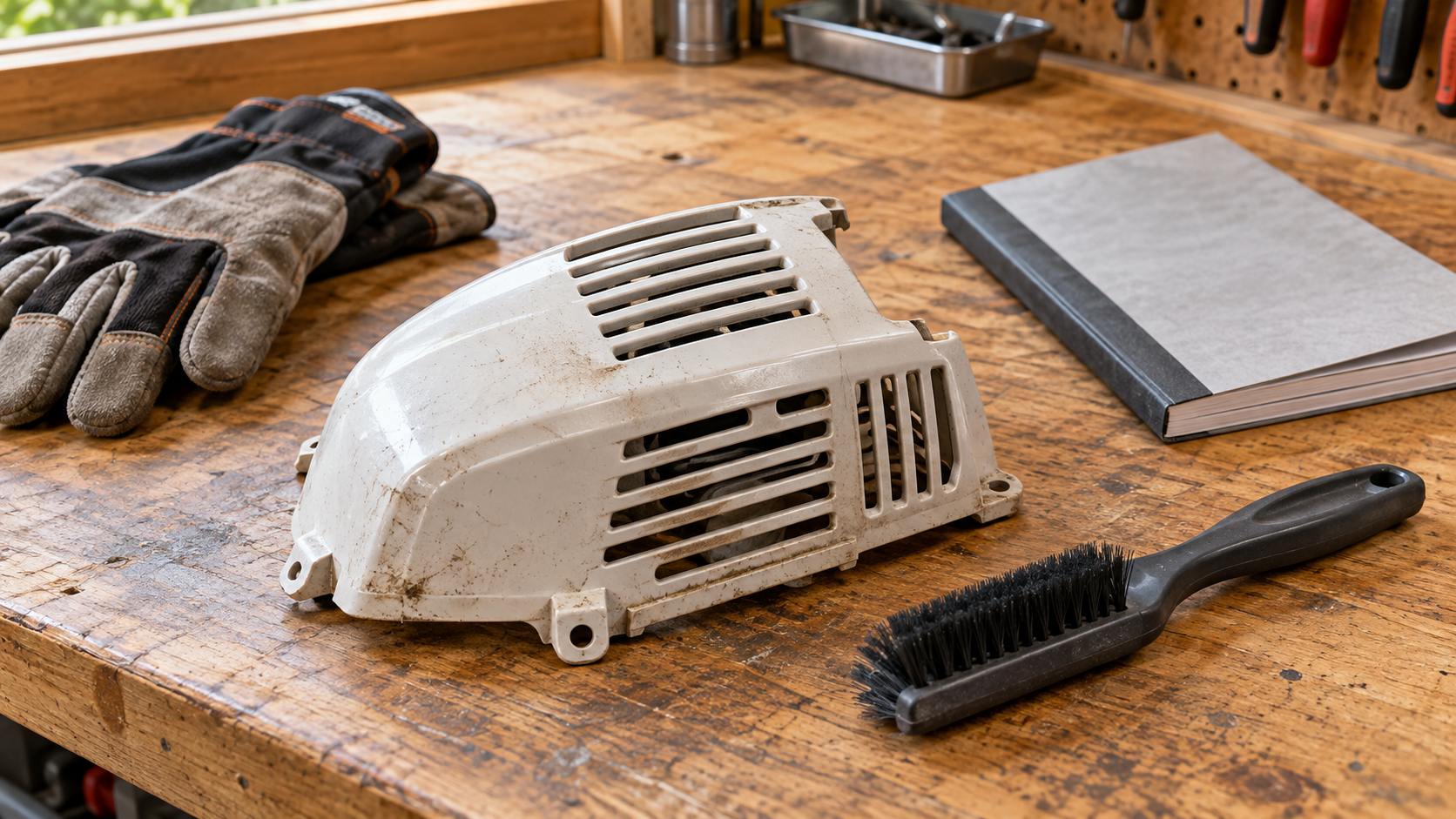
Illustrative preparation scene. Cover fasteners, cleaning access and service limits must come from the exact saw manual.
Make the first record after the saw is cool
Turn the engine off and wait before cleaning or touching the saw. CCOHS directs owners to follow the operator manual for maintenance and repair, and to leave work not described there to qualified service staff. Do not restart repeatedly just to see whether the symptom returns.
Write down where the heat or smoke appeared, what the saw was doing, and what changed first. “The saw got hot” loses the distinction that Husqvarna uses in its smoke diagnostic: an engine-area symptom and excess friction at the chain and bar lead to different checks.
Use the heat-location card
This card is an editorial observation tool, not a substitute for a model diagnostic.
| What you can safely observe | Keep the next check limited to | Stop boundary |
|---|---|---|
| Smoke, unusual heat, or debris is around the cylinder cover, cooling slots, or air-intake area | The manual’s permitted cooling-air and air-filter inspection | Unknown cover access, damaged housing, or a symptom that persists after the documented check |
| Heat or smoke appears at the chain or guide bar while cutting | Chain sharpness, specified lubrication, tension, and bar/chain condition | A dry oil-output check, smoke, discoloration, binding, or a damaged cutting attachment |
| The location is unclear, or both areas show evidence | Keep the saw out of use and preserve the observations | Do not combine adjustments or guess at an internal cause |
| A battery saw has stopped with an overheat indication | Let it cool and use the model’s support/manual path | Do not use petrol-saw cleaning or fuel advice as a battery fault procedure |
The point is to avoid a common shortcut: treating every hot saw as an engine problem, or every smoke symptom as a chain-sharpening problem. One clear location gives the next inspection a boundary.
If the evidence is at the engine, inspect airflow—not an internal repair
Husqvarna’s chainsaw cooling guidance calls for inspection and cleaning of cooling flanges, and describes cleaning cooling slots in the starter assembly. ECHO likewise classifies chainsaw cooling-system and air-filter work as model-assigned maintenance. These are not universal disassembly instructions: cover access, fasteners, and the permissible cleaning method vary by saw.
Start with the exterior and the exact manual. If it permits cover removal, use the stated isolation and cover sequence, then brush away loose dust and sawdust from the accessible cooling areas. Do not transfer a cover-removal sequence, a compressed-air method, or a tool choice from a different saw.
An air restriction is a separate check. Husqvarna lists a dirty or blocked air filter as a common engine-smoke cause. Use the manual-led air-filter cleaning guide only for the correct filter material and cleaning method. Do not wash, oil, blow out, or replace a filter by copying a procedure from another model.
Avoid turning an engine-area observation into fuel-mixture adjustment, spark-arrester removal, or carburetor work. Those tasks can be model- and jurisdiction-specific; if the manual does not assign them to the owner, the useful result of this inspection is a clear service record, not a more invasive repair.
If the evidence is at the bar and chain, trace friction in order
Husqvarna separates chain-and-bar smoke from engine smoke and points owners to chain sharpness, lubrication, and tension. CCOHS also notes that both an overly tight chain and poor lubrication increase wear. Work from the least invasive evidence outward:
- Oil: confirm the specified bar-and-chain oil and use only the model’s oil-output check. A dry-looking outer chain is not enough by itself. Follow the bar-oil path diagnostic if the manual’s check does not show delivery.
- Chain travel and tension: with the saw safely disabled, check tension and free movement only as the manual directs. Do not adjust a hot chain; CCOHS cautions that an overly tightened chain can cause damage as it cools.
- Cutting evidence: fine dust, heavy feed pressure, damaged cutters, or a change after contact with abrasive material can point to the cutting side of the problem. The rapid-dulling diagnostic keeps that inspection distinct from cooling-system maintenance.
- Bar and chain condition: stop for binding, a damaged drive link, bar damage, smoke, or discoloration. Correcting one visible contributor does not certify the remaining parts.
Do not run a dry, binding, or smoking cutting attachment to compare heat levels. The purpose of the sequence is to identify a safe next action before more friction changes the evidence.
Treat a repeat symptom as service information
After the manual-permitted maintenance is complete and the saw is fully reassembled, follow its normal pre-use checks. If the same heat or smoke returns, take the observation record to the service route: location, whether the saw was cutting, the condition of the cooling area or cutting attachment, and the exact manual steps already completed.
That record is more useful than a list of internet fixes. It leaves fuel-system, exhaust, ignition, and internal-engine diagnosis with the documentation and equipment those jobs require.