Chainsaw clutch-drum wear is not something to diagnose from a cutting symptom alone. With the saw off, cool, and made unable to start by its own manual, first establish whether you are looking at a removable rim sprocket, an integral spur sprocket, or a drum that needs an exact-model manual or service inspection.
This is a visual-condition and routing guide for a petrol saw already opened only as far as its manual permits. It does not provide a universal clutch, brake-band, bearing, or drum-removal procedure.
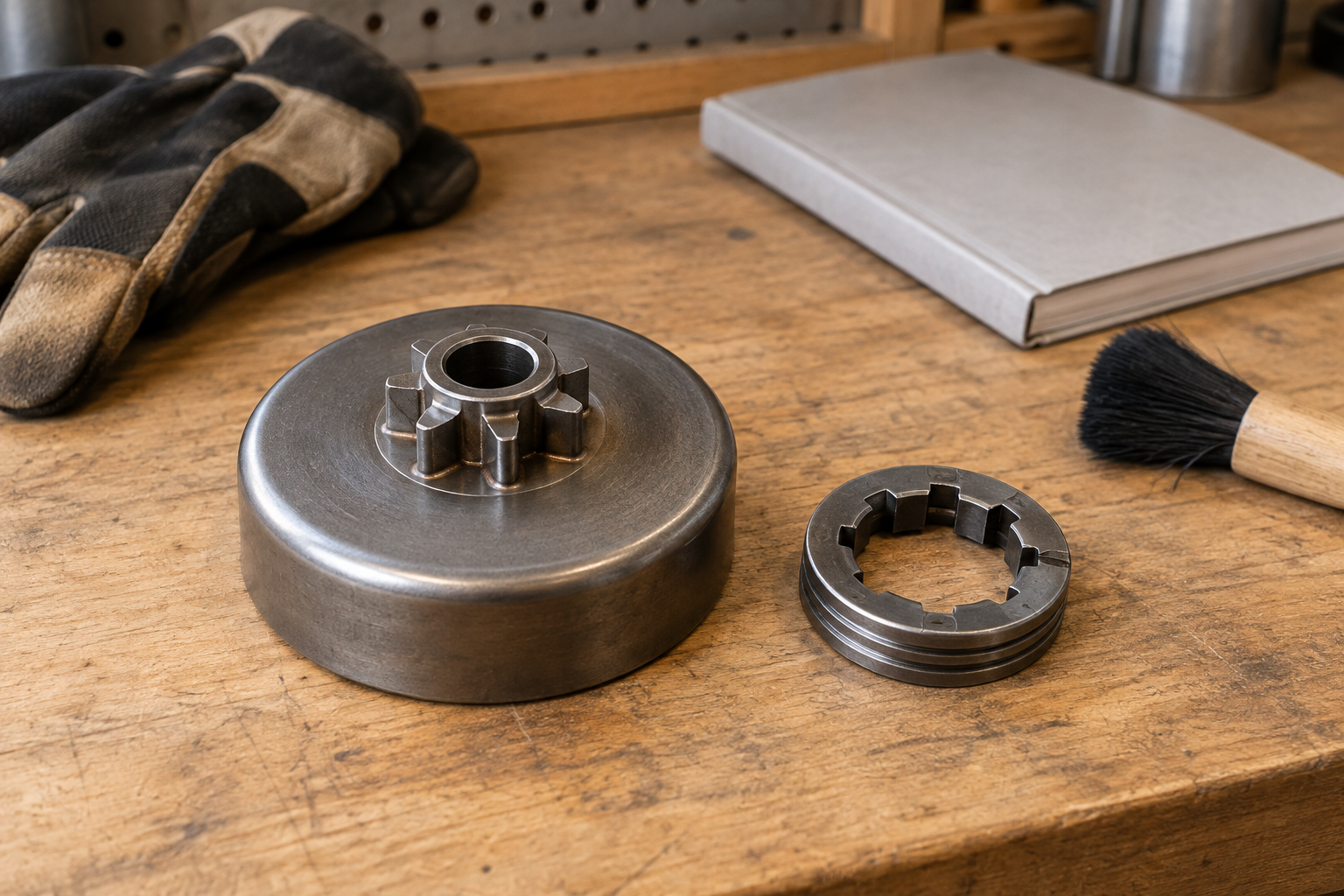
Illustration of separated drive parts only. Shapes, fasteners, part fit, and service limits must come from the exact saw’s documentation.
Start by separating the names
The clutch drum and the chain sprocket work in the same area, but they are not necessarily the same replaceable part. Husqvarna describes two arrangements: a spur sprocket permanently attached to the clutch drum, and a rim sprocket that can be replaced separately. That distinction matters before anyone treats a worn-looking toothed surface as proof that the whole drum needs replacement.
Do not infer the arrangement from a photo, a parts listing for another saw, or an article about a different engine size. Record the saw’s complete model identification, then compare the manual’s drawing and parts terminology with the stationary component in front of you.
Use a part-and-observation card
| What you can establish with the saw disabled | What it means now | Safe next route |
|---|---|---|
| The manual identifies a removable rim sprocket and the drum itself has no visible damage | The sprocket and drum are separate items on this model | Use the manual’s inspection limit and replacement route; do not convert that into a drum diagnosis |
| The manual identifies a spur sprocket integral to the drum | The tooth-bearing part and drum are linked on this model | Use the exact manual or parts/service route for that arrangement; do not order a rim sprocket by appearance |
| A drum is cracked, broken, visibly distorted, or has an unexplained damaged surface | A visible fault has been found, but its cause and related-part condition are not established | Keep the saw out of use and seek the manual-led replacement or service route |
| The outside of the drum is discoloured, or the brake area cannot be cleaned and identified safely | A brake-system concern may be involved as well as a drum observation | Do not run a test; have the exact brake and drum system inspected as the manufacturer directs |
| You cannot tell which component is the drum, sprocket, clutch, or brake band | The part identity is not reliable enough for a repair decision | Refit only as the manual permits, then use the model documentation or a service provider |
Oregon’s maintenance manual treats a cracked or broken drum, obvious drum-skirt wear or discolouration, and excessive wear on the inside of the skirt as replacement or dealer matters—not evidence for a universal repair. That is a useful stop boundary: a close look can identify an abnormal condition, but it cannot tell you why it occurred or which nearby component is still serviceable.
Clean only to make the observation clearer
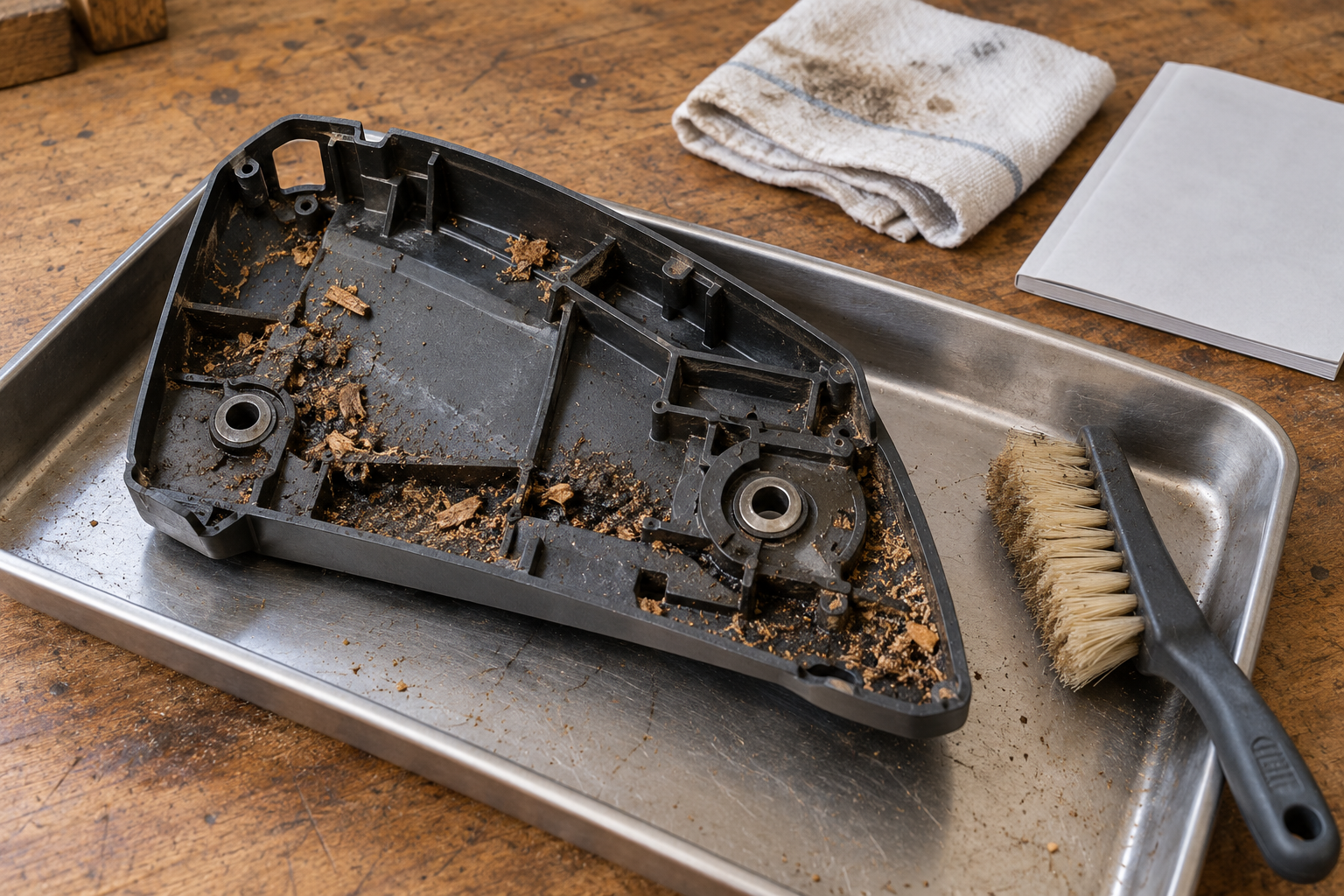
The clutch-cover area commonly collects sawdust and oily residue. Remove material only by the access and cleaning method the exact manual authorises, then look again. The purpose is to reveal the part and its visible condition, not to polish away evidence, alter a friction surface, or free a suspected fault by running the saw.
STIHL notes that the chain-brake band and clutch drum need to stay free of dirt, grease, and other foreign matter for the brake to operate properly. If the brake area cannot be cleaned thoroughly, or its operation has changed, STIHL directs the owner to trained service personnel. Treat that as a brake-system boundary, not a reason to adjust the band or continue using the saw.
Do not turn a drum check into the wrong diagnosis
Several nearby problems can look related without sharing a repair:
- A toothed drive surface may be a sprocket-wear question, especially where the manual distinguishes a replaceable rim sprocket from an integral spur arrangement.
- Repeated chain slack is better handled by the stationary loose-chain diagnostic, which checks mounting movement, tensioner engagement, heat, and cutting-attachment evidence rather than assigning the cause to the drum.
- A chain-brake concern needs the separate chain-brake check. Do not use clutch-drum appearance as proof that the brake is working.
Likewise, a chain that moves when it should not, a changed idle, noise, or a saw that will not drive the chain can involve systems beyond the visible drum. Do not remove a clutch, lubricate a bearing, alter idle speed, or run the saw with parts removed to sort that out. The model-specific manual and service information set the permitted inspection and repair boundary.
What to record before seeking parts or service
Take the saw’s full model identifier from its product label or manual, then note whether the manual calls the arrangement a spur or rim sprocket. Record what is visibly abnormal—crack, break, distortion, marked discolouration, or an area that cannot be cleaned sufficiently to identify—without guessing at a cause. Include whether the chain-brake check itself has changed, but do not treat a visual record as a brake test.
That short record gives a dealer or manufacturer support route something usable to compare against the correct illustrated parts list. It is safer than matching a generic clutch drum to an online image, and it avoids fitting a component that may not work with the saw’s chain brake or oil-drive arrangement.