Choose the chainsaw bar oil type named in the exact saw manual: in ordinary use, that normally means a purpose-formulated bar-and-chain lubricant, not used engine oil. If the manual specifies a cold-weather grade, a biodegradable formulation, or a permitted fallback, follow that model-specific instruction rather than treating one bottle or one online tip as universal.
Oil in the reservoir has one job: to lubricate the chain, guide-bar groove, and related cutting surfaces as the saw operates. It is not fuel, two-stroke mix, hydraulic fluid, or a generic oil category. The label tells you what the bottle is; the manual tells you whether it belongs in your saw and under the current conditions.
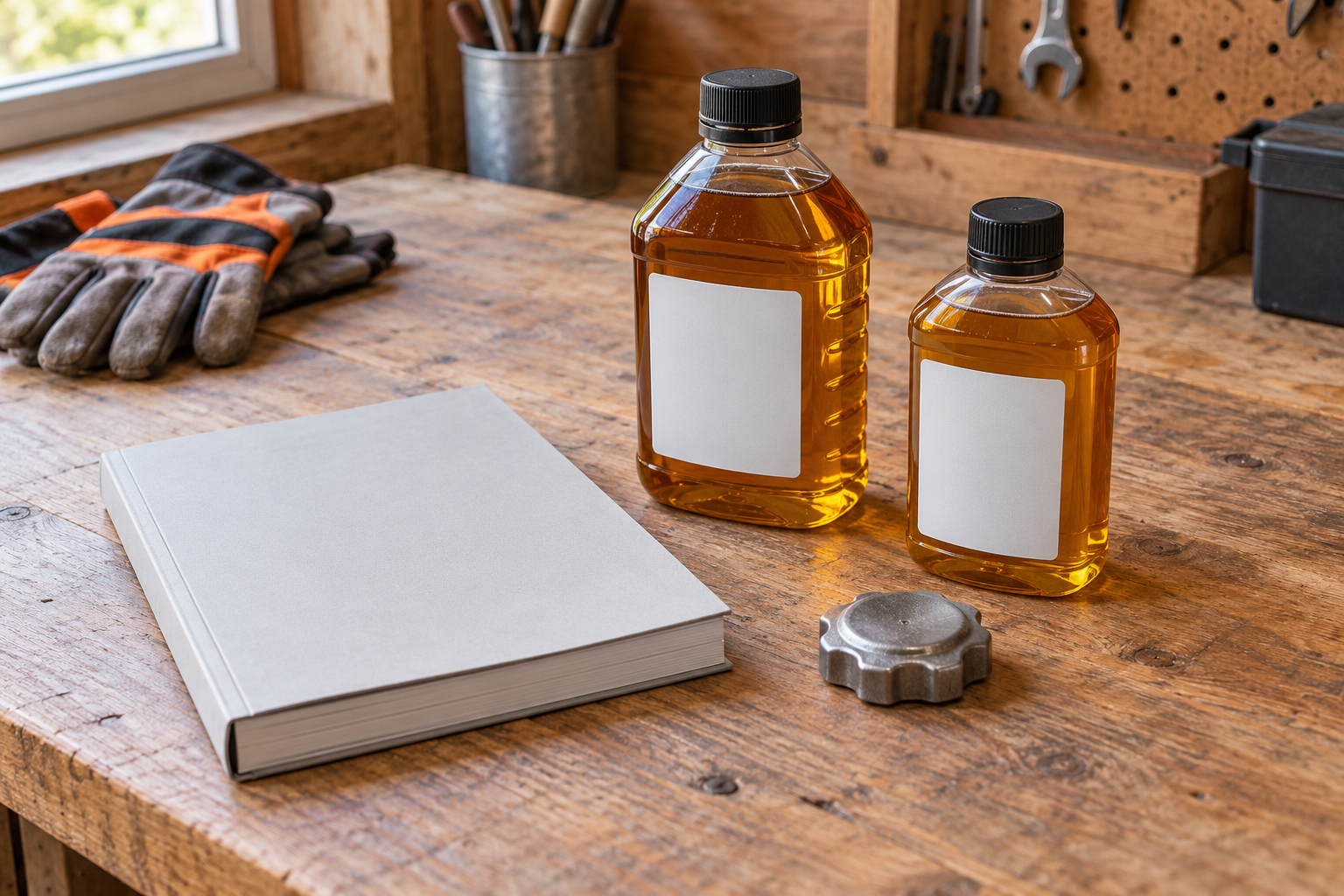
Illustrative selection scene only. The blank bottles do not identify a compatible product, cold-use limit, or reservoir-fill procedure for a particular saw.
Use the manual / condition / product / stop card
Start with the model number and the current operator manual, not the colour or thickness of oil already in a shed. Then use this card to decide what the evidence permits.
| What you can establish | What it means | Next decision |
|---|---|---|
| The manual calls for bar-and-chain lubricant, and the bottle is a clean purpose-formulated bar-and-chain product | You have the basic product category the cutting system is designed to use | Check any model-specific temperature, seasonal, or environmental instruction before filling |
| The manual or product instructions name a cold-use or winter formulation for the actual conditions | The lubricant choice changes with the documented conditions | Use only the stated formulation and its conditions; do not turn another brand’s temperature chart into a rule for this saw |
| A biodegradable bar-and-chain product is being considered | It may be an appropriate formulated product, but its label and the saw instructions still control | Confirm the product is intended for bar-and-chain lubrication and follow the manual for filling and storage |
| The fluid is used oil, unlabeled, contaminated, or offered as a generic substitute | Its suitability is not established by appearance or convenience | Do not fill the reservoir. Obtain the specified product or manufacturer guidance |
This is a selection record, not an oil-flow test. It does not set pump output, prove that oil is reaching the bar, or establish how long a particular reservoir should last.
Why purpose-formulated bar-and-chain oil is the starting point
Manufacturer guidance consistently treats bar-and-chain lubricant as a dedicated cutting-system fluid. STIHL’s chain-maintenance material says that lubricant quality matters to the service life of the chain and guide bar, while Oregon directs owners to keep the oiling system filled with clean bar-and-chain oil. Husqvarna describes its bar-and-chain products as using tackifier additives intended to help lubrication remain on the cutting equipment.
That shared direction gives a practical purchase rule: choose a product that is explicitly made for chainsaw bars and chains, then check the saw manual for additional requirements. It does not prove that every bottle marketed for chainsaws suits every model, temperature, or environmental requirement.
Used engine oil is a separate no-go category. Husqvarna warns that waste oil can carry particles, lack the additives needed to stay where lubrication is required, and create environmental and handling concerns. STIHL’s manual likewise says not to use waste oil. Do not strain, settle, or blend used oil in an attempt to turn it into chain lubricant.
Treat cold conditions as a manual question, not a viscosity guess
Cold weather can change how a lubricant flows. STIHL’s maintenance guidance notes that ordinary chain oil can become too thick at very low temperatures and points owners to a winter-grade product for those conditions. That is useful evidence to look for a seasonal instruction; it is not permission to choose a universal number, thin a product, or change an adjustable oiler by habit.
Before work in cold conditions, check three documents or labels:
- the saw’s manual for any permitted lubricant or oil-flow instruction;
- the bar-and-chain product label for its stated use conditions; and
- any separate bar or chain documentation required by the manufacturer.
If those sources conflict, the saw manufacturer’s support channel or servicing dealer is a better next step than a guessed blend. Do not add fuel, solvent, used oil, or another liquid to alter flow.
A biodegradable label does not remove the compatibility check
Biodegradable bar-and-chain products exist as formulated lubricants. Husqvarna’s X-Guard biodegradable product, for example, is sold as bar-and-chain oil and describes a vegetable-based formulation with tackifier and wear-protection features. That helps distinguish a purpose-made biodegradable product from pouring an unverified household or cooking oil into the reservoir.
Still, a product label does not replace the manual. The saw may have its own seasonal instructions, local worksite rules may affect what can be used, and long storage can have a different procedure from daily operation. Keep those questions separate instead of assuming that “biodegradable” settles every operating, storage, or disposal decision.
Separate a product choice from an oiling fault
Correct oil in the tank does not prove that it is moving through the system. If the manual-approved product is present but the chain is dry, the reservoir level does not change in normal use, or the manufacturer’s lubrication check fails, stop cutting and use the bar-oil troubleshooting guide. That is an oil-path diagnosis, not a reason to switch products repeatedly.
Likewise, oil that appears under a parked saw is not evidence that the bottle was the wrong type. The stored-oil leak guide separates retained cutting-attachment residue from a new leak that needs service. For the broader pre-use sequence—cutting attachment, tension, oil level, and visible damage—use the chain-maintenance checklist.
Do not run the saw simply to compare two oils. Follow the exact manual’s oil-level, filling, and lubrication-verification steps, with the required protective equipment and clear work area.
Stop before filling when the identity is uncertain
Pause and obtain the manual or manufacturer guidance when any of these is true:
- the saw model cannot be identified or its manual is unavailable;
- the bottle is unlabeled, old, contaminated, or described only as motor, hydraulic, cooking, or recycled oil;
- the manual gives a condition or formulation requirement you cannot match to the label;
- the saw has a documented lubrication fault, smoke, binding, or abnormal cutting-system heat; or
- a local environmental requirement appears to conflict with the available product.
Record the saw model, manual wording, product name, and outdoor conditions before asking a dealer or manufacturer for help. That is more useful than reporting that the oil “looked right,” and it keeps a routine refill from becoming an improvised lubrication experiment.