Replace a chainsaw helmet after an impact, when its condition fails the manufacturer’s inspection, or when it reaches the lifetime limit in its instructions. A clean-looking shell does not cancel an incident history or extend that limit; inspect the suspension and attached protection separately.
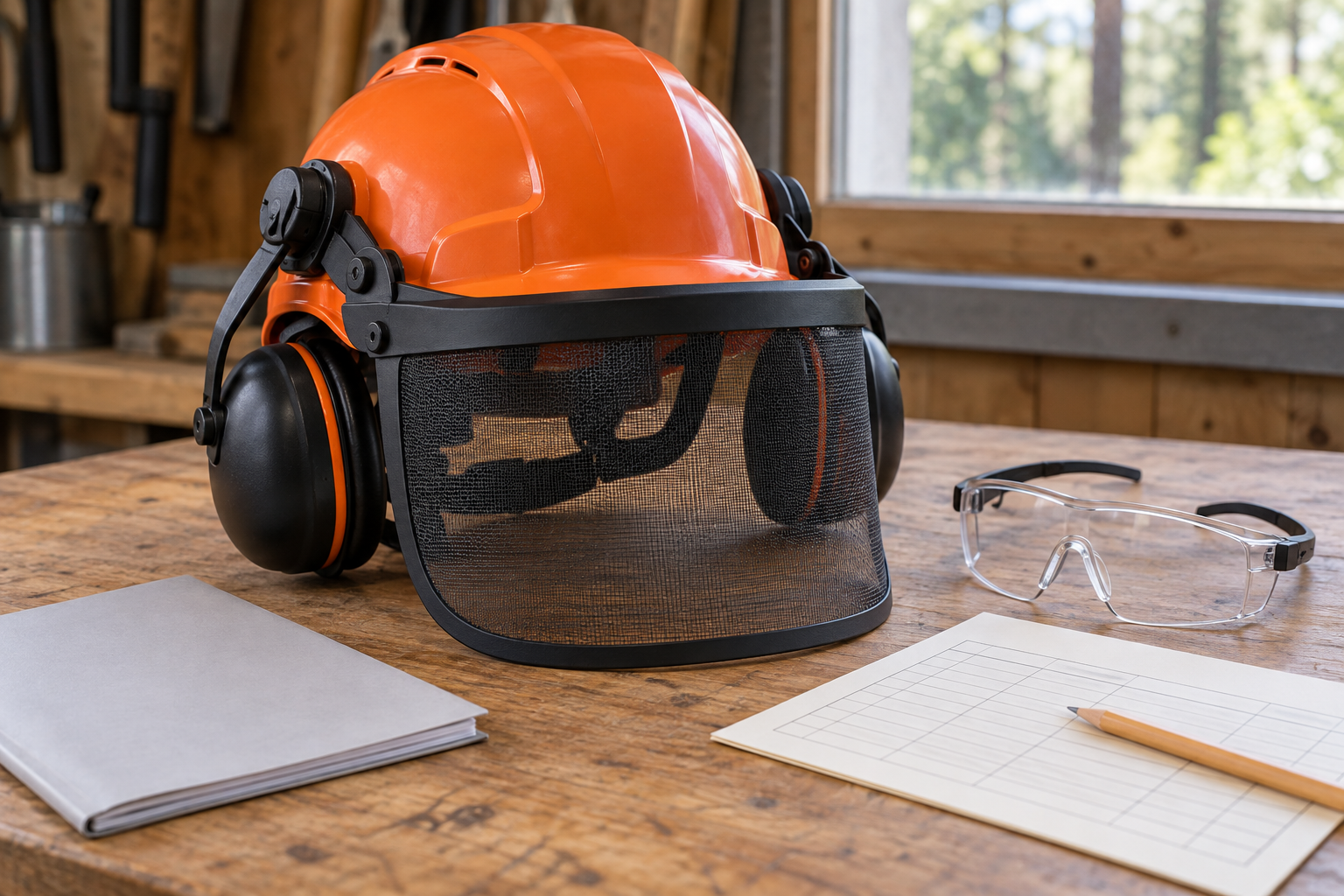
This guide is for an owner checking an existing forestry helmet before a firewood session. The illustration shows an inspection setup, not a certified product or evidence that a particular helmet passes. For the rest of the equipment set, use the firewood PPE pre-start check.
Is the date inside the helmet an expiry date?
Identify the maker and model first, then find the matching instructions. Delta Plus explains that a manufacture date is usually marked inside the helmet. That date tells you when the product was made; the applicable instructions tell you how to use it when deciding retirement.
Do not substitute the purchase receipt for the manufacture marking. A helmet may have been made before you bought it. Record both dates if available, and keep any first-use date separately when the instructions require it. If a marking cannot be interpreted, photograph it and ask the manufacturer or dealer rather than guessing which arrow, number or label is relevant.
As one specific example, the March 2025 Husqvarna H300/H300 Mips manual prohibits using those helmets longer than five years from production. That is a limit for the named models, not a five-year allowance for every forestry helmet. The University of Georgia gives general three-to-five-year replacement advice while also directing readers to the manufacturer’s recommendation.
Write the actual instruction beside the date. “Five years” without the model, starting point and document is an incomplete record. An age limit is also not a promise that equipment remains usable until then.
Make one inspection record before deciding what to buy
Use the following as a worksheet, with the helmet and its instructions in front of you. It organizes observations; it does not measure impact protection or certify continued use.
| Record field | What to write | What an unanswered field means |
|---|---|---|
| Identity and instructions | Maker, model, matching document and relevant page | Obtain the correct instructions before applying a lifetime or parts rule |
| Dates | Manufacture marking, purchase date, first-use date if relevant, and the stated retirement rule | Ask the maker to interpret unclear markings or missing history |
| Incident history | What struck the helmet or what accident occurred | Keep an uncertain incident history unresolved rather than writing “no damage” |
| Shell and suspension | Location of each finding, with photographs when useful | A general note saying “looks fine” does not document the prescribed checks |
| Visor and hearing protection | Their identities, attachment condition and separate care instructions | Do not assume that shell instructions cover every accessory |
| Decision and evidence | Retire, obtain manufacturer advice, or fit a specifically approved replacement part | Keep equipment awaiting a decision separate from the ready-to-use set |
An enquiry built from this record is more useful than “Is my helmet too old?” It tells the service provider which product you have, what happened to it and which uncertainty needs resolving. Keep the reply with the record so another person does not repeat an already answered question.
What if it took a hit but still looks normal?
Take it out of use. CCOHS directs replacement of headwear that has been struck even when damage is not visible. Delta Plus likewise calls for replacement after a significant impact despite an apparently intact exterior. A successful visual inspection cannot erase that history.
Do not drop, strike or load the helmet to see whether it will survive another blow. Ask the manufacturer about an uncertain event before returning it to use. Record the event before cleaning or changing parts makes the original condition harder to describe.
Which physical findings matter?
Start outside, then examine the internal support according to its instructions. Georgia’s chainsaw PPE guidance identifies dents, penetration, plastic flaking, discoloration and chalking as replacement signs. It also calls for immediate replacement of a worn or broken liner. These are reasons to stop, not cosmetic defects to conceal.
CCOHS identifies suspension wear such as frayed material, torn adjustment slots and damaged attachment tabs. It warns against alterations and against combining one manufacturer’s suspension with another manufacturer’s product. A replacement that clips into a slot is not thereby an approved match.
Delta Plus adds checks of harness fastenings, adjustment mechanisms and attached accessories. Check that a chin strap, where fitted, has intact material, a functioning closure and secure attachments. Follow the model’s fit procedure after any permitted work; buying a new part does not complete reassembly and adjustment.
Can a new visor or earmuff cushion save the helmet?
An accessory replacement answers an accessory problem. It does not reverse shell age, impact history or damage elsewhere. Ask which exact part the maker permits, then check the rest of the assembly before deciding that the job is complete.
The H300 manual gives separate instructions for its visor and hearing protectors, illustrating why one retirement date should not be assumed for an entire assembly. It also states that a mesh visor does not replace safety glasses or goggles. Replacing mesh therefore does not finish the eye-protection check.
If your shell, suspension or accessories cannot be identified, leave the parts order open until the manufacturer resolves compatibility. Avoid choosing a substitute from appearance alone. Keep any removed, rejected item from being mistaken for a usable spare.
Keep the history with the equipment
Storage and cleaning matter between inspections. Husqvarna’s helmet-care guidance recommends cool, dark storage and mild lukewarm soapy water, and warns about alcohol or solvent products. Follow the instructions for your model and each accessory rather than washing the whole assembly by one remembered method.
If your helmet has a UV indicator, read its model-specific directions. Husqvarna describes the indicator as additional information about exposure; it is not a substitute for the other checks. Do not invent a colour rule for an unfamiliar indicator.
Keep the manual and inspection record where the helmet is collected. Note unresolved findings before the next trip, and replace the required equipment before cutting. Handle clothing care separately using the chainsaw chaps washing guide; its cleaning instructions do not apply to a helmet.