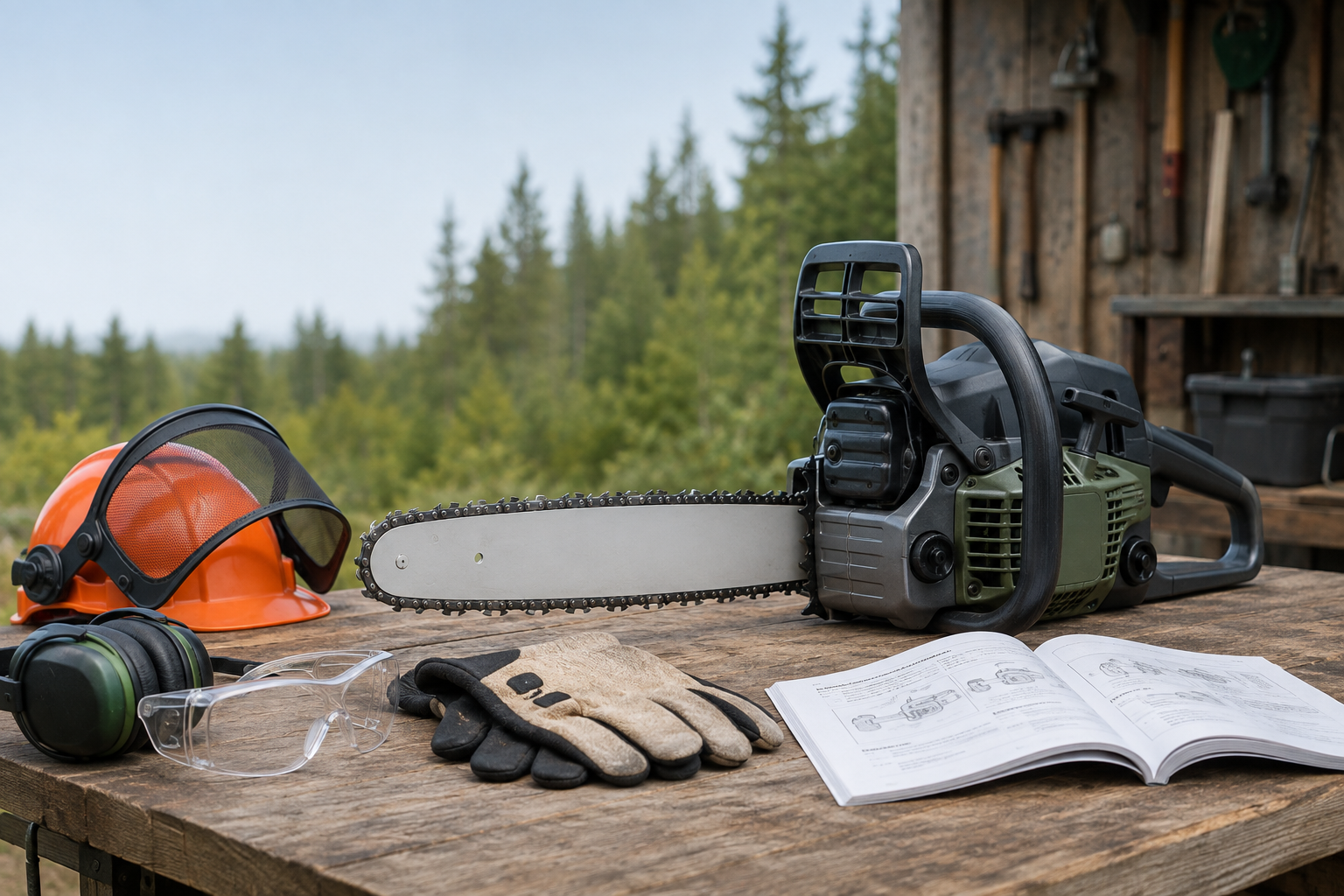
To transport a chainsaw, switch it off, let it cool, engage the chain brake, fit the bar guard, and secure the saw and its equipment against movement. Remove a detachable battery as its manual directs, and choose a cargo location outside the passenger compartment.
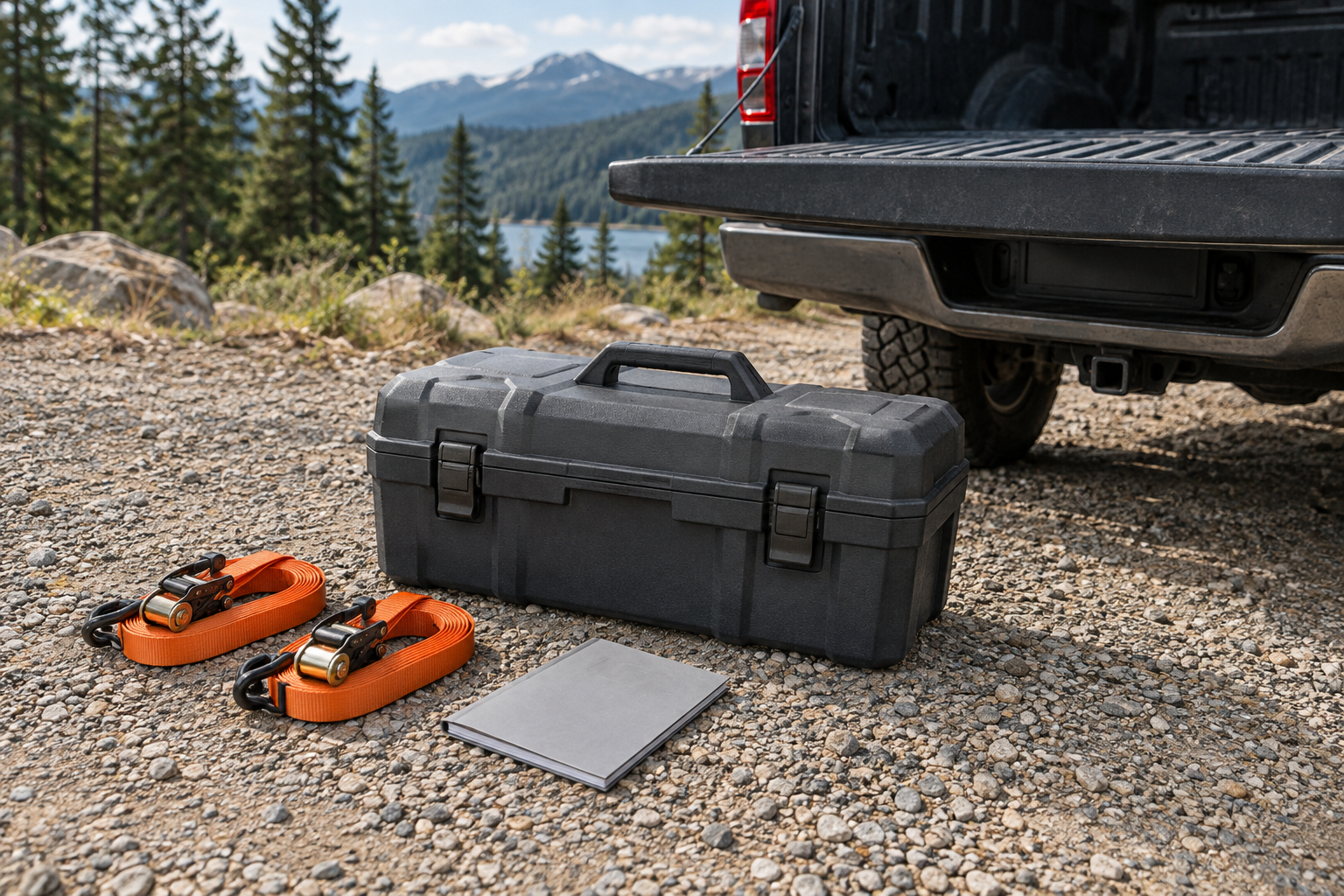
This guide covers moving a saw by vehicle to a work site. The cover image shows preparation equipment before loading; it does not show a completed restraint arrangement. Use your saw, carrying-case and vehicle instructions to choose the actual equipment and attachment method.
Before lifting: finish work and prepare for the journey
Start with the transport section of the exact saw manual. Keep it available through unloading, especially if another person will use the saw at the destination. A shutdown procedure, a transport procedure and a winter-storage procedure may contain different instructions.
For a petrol saw, stop the engine and allow it to cool before loading. CCOHS specifically calls for cooling before transport. Follow the manufacturer’s instructions for the tank contents and closure checks; do not treat a loose cap or leaking saw as a packing problem that a box will solve.
For a detachable-battery saw, take the pack out before carrying or loading when instructed. EGO’s chainsaw support explicitly requires battery removal for transport, as well as fitting the guide-bar sheath. Record where the removed pack is packed so that it is not left behind or mistaken for equipment already installed in the saw.
For a corded saw, disconnect the supply before packing. Keep the tool lead and any extension cord accounted for as separate parts of the load. Their place in the vehicle should be chosen alongside the saw, not discovered after other equipment has been piled on top.
Fit the correct guard over the cutting attachment. If it will not fit, stop and resolve the mismatch using the saw’s instructions. Do not make an exposed section of chain acceptable merely by turning that section toward the vehicle wall.
Carry it to the vehicle with a clear destination
Choose the loading place before picking up the saw. That lets you carry it directly to a prepared position rather than holding it while someone rearranges the vehicle.
NASA’s ABoVE chainsaw training places the bar and chain toward the rear and outside of the person carrying the saw, keeping the muffler away from the body. CCOHS also calls for the brake to be engaged and the chain covered. Use the carrying handle specified by the saw manufacturer.
Instructions for a tree-service saw can include special attachment rings and climbing equipment. Those instructions are specific to that equipment and trained work; they are not a reason to carry an ordinary saw by its bar guard or invent a suspension point.
Accept the load in four parts
The following loading card is an editorial way to apply the sources’ guard and restraint instructions. It is not a test of crash resistance or a substitute for rated equipment and its instructions.
| Part to account for | Question to answer before departure | If the answer is missing |
|---|---|---|
| Cutting attachment | Does its fitted guard cover the chain as the saw manual requires? | Resolve the guard fit before loading. |
| Saw | What prevents the saw from moving or tipping in its chosen position? | Choose a suitable restraint or purpose-made carrying arrangement. |
| Carrying case, if used | What secures the case to the cargo location? | Follow the case and vehicle instructions before accepting the load. |
| Separate equipment | Where are the removed battery, tools and containers, and what holds each in place? | Give each item a defined place and restraint. |
Read across all four rows. A guarded chain answers the first question only. A case answers the third question only when the case itself is secured. This distinction is easy to miss when a load looks tidy but nobody can identify what holds its components in place.
For example, if the saw is packed in a suitable case but the case is loose, the record still has an unresolved case row. If the case is secured but a separate battery package is not, the equipment row remains unresolved. Correct the incomplete part rather than marking the whole load ready because one item has been fastened.
CCOHS calls for securing the saw, accessories, containers and case. STIHL’s MSA 190 T manual separately requires restraint of the saw and of the battery packaging; the pack must also be unable to move inside that packaging. Those are useful distinctions when reading your own model’s instructions, without importing that tree-service saw’s other settings.
Choose the cargo location and fuel procedure deliberately
Keep the saw, fuel and oil out of the passenger compartment, as CCOHS directs. A case does not change that instruction. If the available vehicle cannot provide an appropriate cargo arrangement, resolve the transport plan before departure.
For petrol equipment, Missouri Extension recommends a level position with the fuel cap uppermost and prevention of tip-over. NASA’s transport guidance likewise combines fuel-cap-up placement with restraint. These instructions work together: orientation describes the intended position; restraint keeps the equipment in that position during the journey.
Read fuel instructions under the correct heading. Missouri discusses draining the tank under long-term storage, separately from its vehicle-transport advice. Do not turn a storage routine into a universal requirement to drain every saw for every short trip. Conversely, do not assume a short trip overrides a draining instruction in your model’s transport section.
When the manual requires draining, use its procedure and a suitable approved container. Keep fuel and oil away from ignition sources. For a longer period out of service, use the separate chainsaw storage checklist rather than extending this trip checklist into a seasonal fuel or battery prescription.
A battery also has its own transport instructions. STIHL’s cited manual prohibits transport of a damaged pack. Do not put a suspect pack in the ordinary tool load for convenience; contact its manufacturer for the appropriate handling route. Air travel, shipping and commercial carriage need their own applicable instructions and are outside this article’s scope.
At arrival: compare the load before reconnecting power
Use the four rows again while the saw remains off. Record any displaced guard, shifted case, loose package or visible leak before repacking hides it. This arrival comparison is a prompt to investigate a change, not proof that an apparently unchanged saw is ready to cut.
If something moved, correct the transport arrangement for the return journey as well. Do not simply put it back and assume the same packing will behave differently next time. If damage or a leak is present, follow the equipment manufacturer’s inspection and service instructions before use.
Unload to a suitable work area, then perform the saw’s prescribed pre-use checks. The chainsaw maintenance checklist helps organize that inspection; the exact manual still controls adjustments and functional checks. Reconnect power or refuel only at the stage that procedure requires.
Keep any unresolved item on the record: which component changed, what was observed, and what must be corrected. The next person should see that note before trying to start the saw.