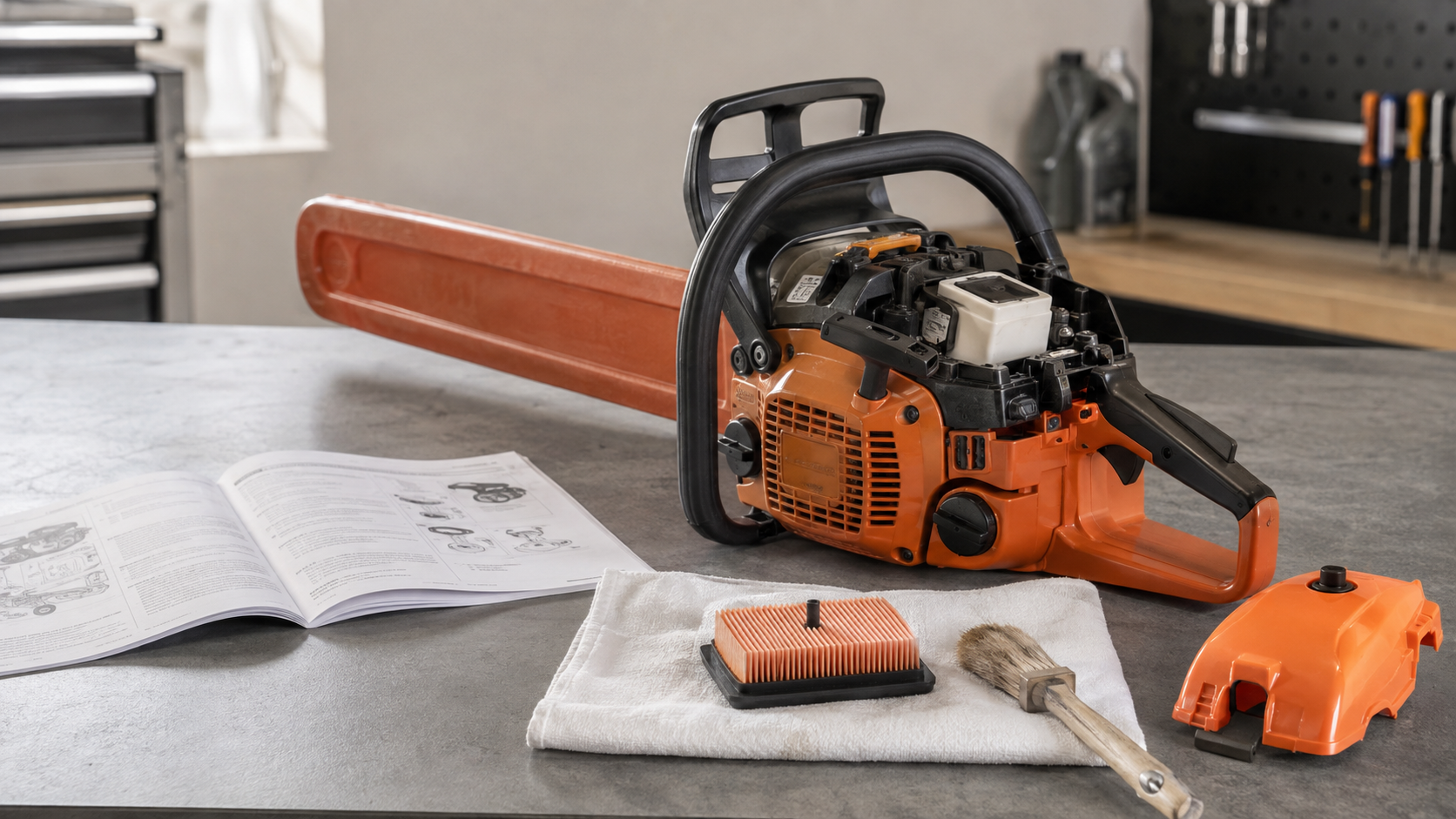
A petrol chainsaw that starts then dies usually needs its fuel, starting procedure, air path, or fuel-delivery system checked—not another round of random carburetor adjustments. Stop repeated starts, use the exact operator manual, and record when the engine stops; that pattern tells you which owner-level check is worth making.
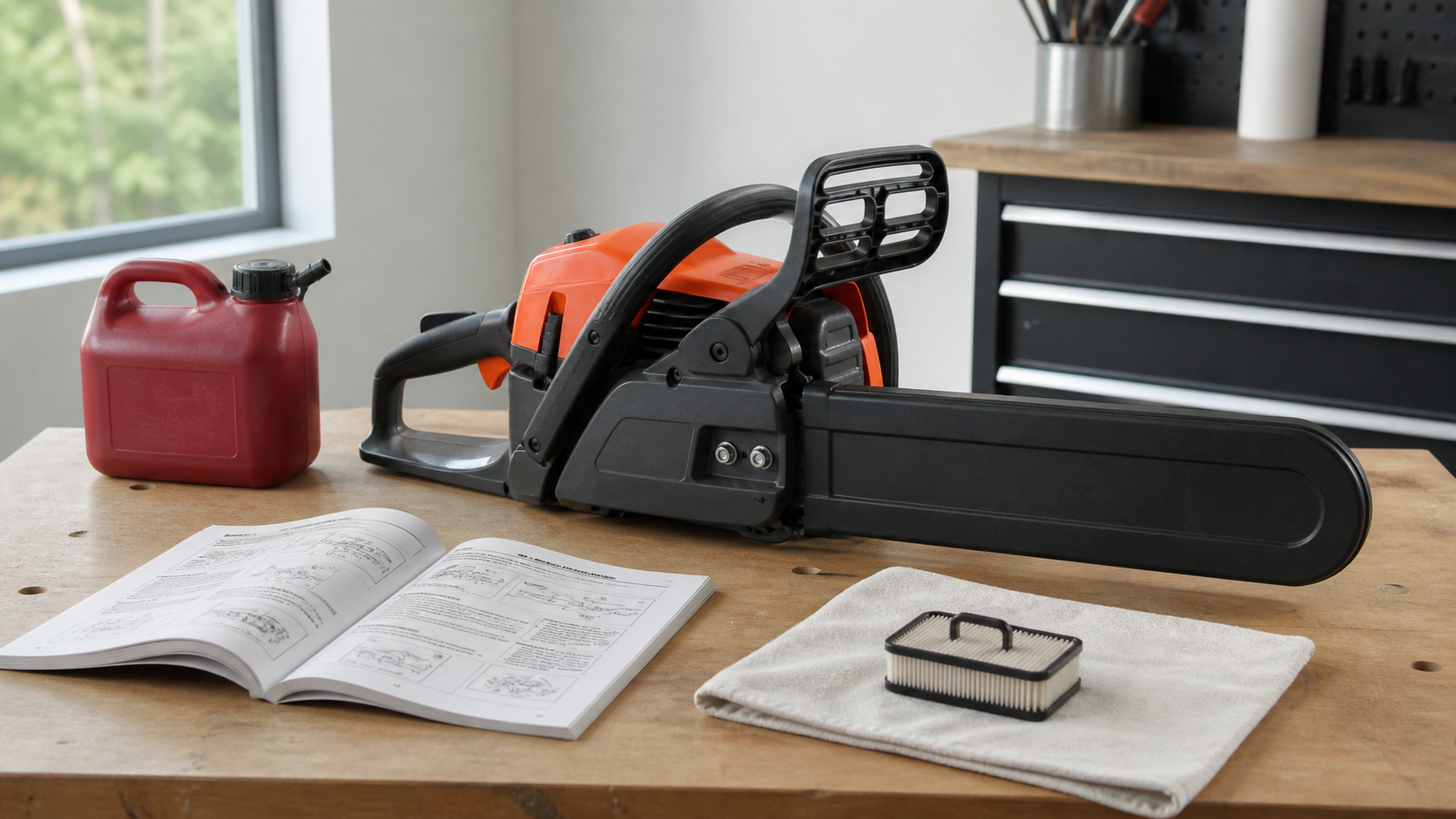
First, make the saw safe to inspect
Let the engine cool. Engage the chain brake, switch the saw off, and work outdoors or in a well-ventilated place away from ignition sources. Fit the bar cover whenever you are not checking the cutting attachment.
Do not keep restarting a saw that leaks fuel, has damaged fuel lines, produces abnormal smoke or heat, or lets the chain move at idle. Those observations are stop conditions, not invitations to tune around the fault. OSHA’s chainsaw guidance also calls for checking controls, chain tension, fasteners, and the fuel and oil systems before starting.
Write a symptom card before the next attempt
Use one permitted start, following the cold- or warm-start sequence in your manual. Record the result instead of relying on “it ran briefly.”
- Duration: fires once, runs for seconds, or runs until warm.
- Control change: dies when the choke is opened, at idle, or when throttle is applied.
- Position: changes when the saw is level, upright, or turned for a cut.
- Chain at idle: stays still or begins moving.
- Recent history: fresh refill, long storage, fall or impact, filter service, or an earlier fuel leak.
The card does not prove which component failed. It keeps separate symptoms from being collapsed into one guess and gives a servicing dealer useful evidence if the owner checks do not resolve the fault.
Follow the branch that matches the evidence
It fires, then dies after a cold start
Re-read the model’s starting sequence first. Some manuals require the choke to be disengaged as soon as the engine fires; leaving it engaged can over-fuel the next attempts. If you smell strong fuel or the saw has endured repeated full-choke pulls, stop and follow the manual’s flooded-engine procedure rather than improvising one.
Then verify that the tank contains the fuel type and mixture specified for that exact saw. If the fuel predates storage or its identity is uncertain, use the manufacturer’s drain and refill procedure and local disposal rules. The chainsaw storage checklist explains why the manual—not a universal storage recipe—must govern fuel handling.
It runs briefly, then loses speed
With the engine stopped and cool, inspect only the air filter, spark-arrestor screen, and cooling openings that the owner-maintenance section exposes. Husqvarna and ECHO both identify restricted intake or exhaust paths among causes of stalling or poor acceleration, but cleaning methods differ by filter and model. Replace damaged elements; do not run the engine with the filter removed as a diagnostic shortcut.
A dirty spark plug can also be evidence, but use the specified plug and gap from the saw’s manual. A wet or fouled plug does not by itself identify whether the underlying problem is the starting sequence, fuel mixture, airflow, or another fault.
It dies when tilted or after a repeatable interval
A position-sensitive stall points toward fuel pickup or delivery rather than cutter sharpness. Husqvarna advises checking for a missing or damaged fuel filter, incorrect or damaged fuel lines, and leaks when a saw dies sideways. Keep a leaking or visibly damaged system out of service and use an authorised service route.
If the saw restarts only after sitting, note the run time and cooling time. A blocked tank vent is one manufacturer-documented possibility, but cap handling and vent service are model-specific and involve fuel vapour. Do not perform an internet-derived cap-open running test; give the pattern to a dealer or follow the exact manufacturer’s diagnostic instructions.
It dies at idle, or the chain moves at idle
Do not use throttle to disguise an idle fault. The Husqvarna manual reviewed for this article sends incorrect idle speed in its “engine starts but stops again” table to a servicing dealer, and warns not to use a saw if the chain will not stop at idle after permitted adjustment.
Carburetor limits and procedures vary with model and emissions requirements. If your manual does not clearly place an adjustment in owner maintenance, leave it intact. Random screw changes can obscure the original symptom and create a second problem.
Decide: clean, refill, or hand it over
Clean within the manual when an accessible filter or screen is dirty but undamaged and the manual provides the method. Refill by the manual when fuel identity or age is uncertain and there is no leak. Arrange service when the symptom persists with correct fuel and clean owner-serviceable parts, changes with position, appears only hot, involves damaged fuel components, or lets the chain move at idle.
Once the engine fault is resolved, inspect the bar, chain, lubrication route, and tension while the saw is stationary; the bar-and-chain maintenance workflow keeps that separate from engine diagnosis. If intact cutters then need bench maintenance, the KonKell 250W High-Speed Chainsaw Sharpener is a mountable electric grinder intended for repeatable chain sharpening. It cannot diagnose or correct fuel, airflow, ignition, idle, or internal engine faults, and wheel-to-chain compatibility still has to be verified before grinding.