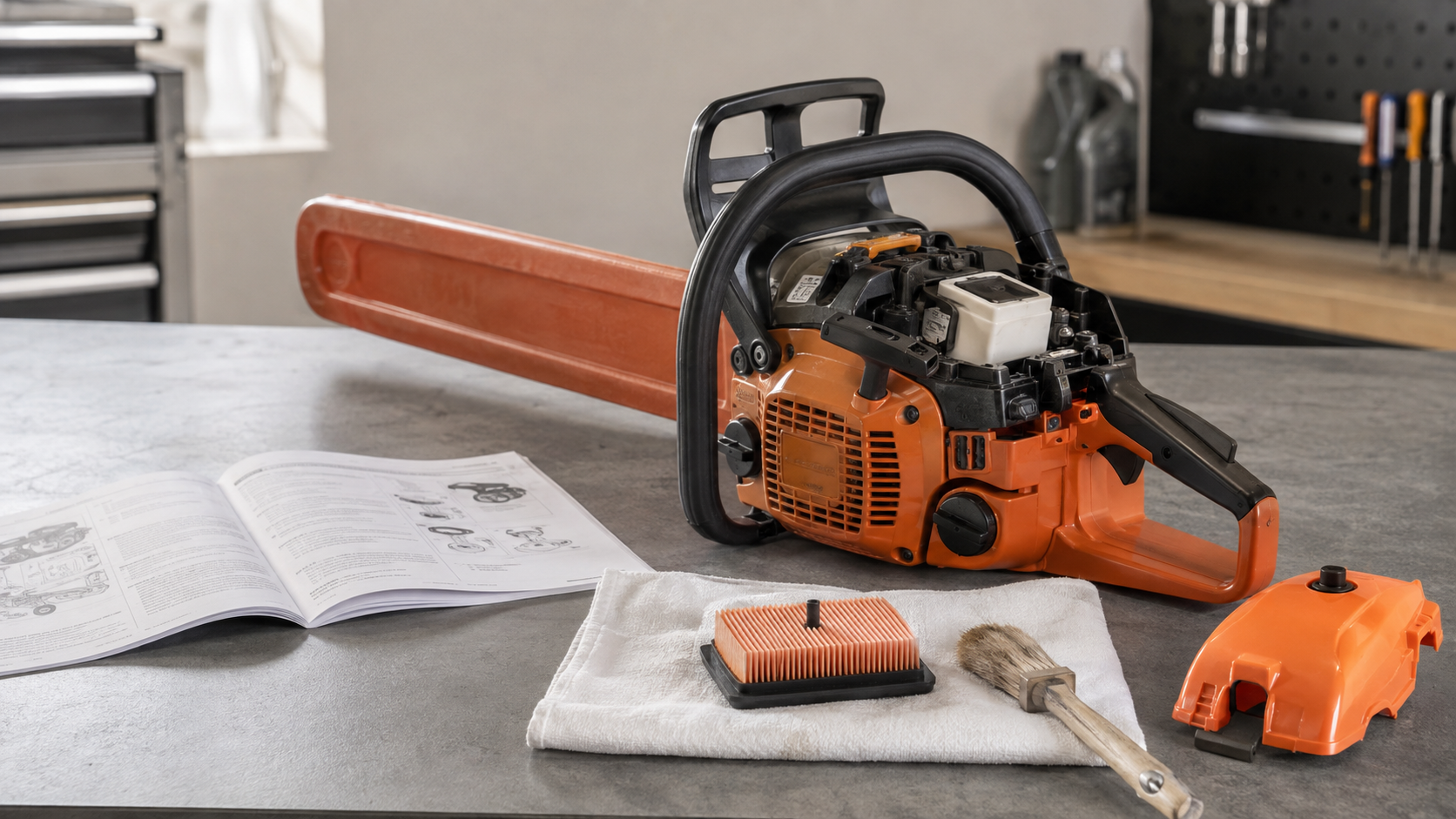
If a chainsaw starter rope will not pull, stops partway, or will not retract, do not force it. First distinguish the normal resistance described in the starting instructions from a changed rope path, visible rope damage, or a starter fault that needs the exact manual or a service provider.
This guide is for a petrol saw that is switched off and cool. It does not give a generic recoil-spring, pulley, cylinder, or starter-cover repair procedure; those details and their safe limits vary by model.
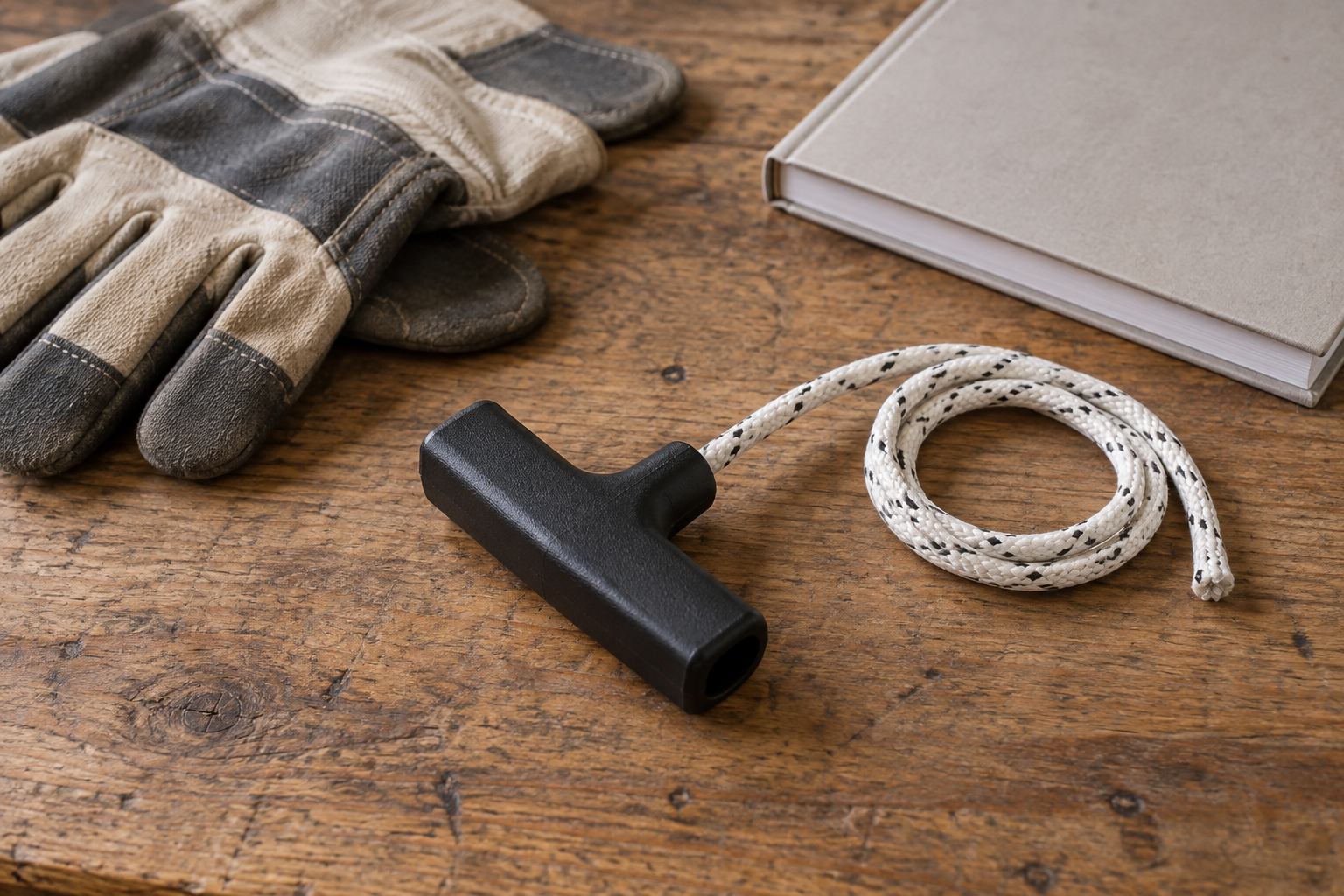
Illustrative preparation scene only. Rope diameter, length, handle shape and starter parts must come from the exact saw’s documentation.
Start with the normal pull, not a diagnosis
A healthy starter rope is not weightless. STIHL and Husqvarna both describe taking up the rope slowly until the starter engages or resistance is felt, then using the documented pull. That expected resistance is different from a rope that suddenly stops at the same point, will barely move, changes its travel, or fails to return.
Use the saw’s current operator manual to check its starting position, control sequence and any decompression device before calling a normal pull a fault. ECHO and CCOHS both require a stable saw, a clear bar and chain, and the chain brake engaged for starting. Do not test this by drop-starting or by putting the saw against your body.
The manual also decides whether a particular starting aid applies to the model. A decompression control on one saw is not an instruction to alter or add one to another saw.
Use the pull / return / stop card
With the saw powered down by the method in its manual, look at the rope and handle from the outside. Do not pull repeatedly in an attempt to overcome a jam.
| What you observe | Decision for this job | Next step |
|---|---|---|
| Rope pulls through the documented stroke and returns smoothly | No starter-jam evidence from that observation alone | Follow the manual’s normal starting sequence; if it cranks and fires but will not run, record that separate symptom. |
| Rope is thinning, badly dirty, damaged, the handle is damaged, or return is incomplete | Treat the starter as needing service | Use the exact manual’s rope/starter procedure or arrange service; do not choose rope size by appearance. |
| Rope stops, will not move, or travel has changed after the permitted external check | Keep the saw out of service | Do not force the handle or open a tensioned recoil system without the model-specific procedure. |
Husqvarna lists a damaged handle, thinning rope, incorrect rope size and buildup that cannot be cleaned among reasons to replace a pull cord. Those are useful observations, not permission to transfer a rope length, pulley winding count or replacement method from another saw.
Make one limited external check
Let the engine cool, set the saw on a stable surface, and follow the manual’s procedure to prevent an unintended start before any maintenance. If the rope has just jammed, do not put the saw back into use until the cause is understood.
Husqvarna’s support route for a jammed starter rope begins with clearing foreign material from the cover air fins. Follow that only to the extent that your saw’s cover-access instructions permit. Brush away loose material rather than driving debris farther into the housing, and stop if the cover, fastener or surrounding part is damaged or access differs from the manual.
This is intentionally a narrow check. It does not establish that a recoil spring, pulley, starter pawl, flywheel, piston or other internal part is sound. If clearing permitted external debris does not restore normal movement, preserve the evidence rather than escalating through force.
Keep three symptoms separate
The words “won’t start” often hide different jobs. Sorting them prevents an internet repair sequence for one symptom from being used on another.
- The rope moves and the engine cranks, but the saw fires and dies. The starter has completed its basic job. Use the starts-then-dies symptom record rather than opening the recoil system.
- The rope moves and returns, but the engine will not fire. Follow the exact manual’s starting and maintenance path. A spark-plug inspection can be appropriate only after isolation and access are covered by that model’s instructions.
- The rope does not move, stops sharply, or does not return. Keep the question with the starter system. Do not turn it into a fuel, ignition or carburetor diagnosis without evidence.
Write down what changed: whether the rope stopped at a repeatable point, whether it returned at all, what was visible around the cover, and whether the problem followed a fall, heavy debris exposure or a prior rope problem. That is more useful to a dealer than “it feels stuck.”
Why the recoil system is a stop boundary
The starter rope, pulley and rewind spring work together under stored tension. Husqvarna’s pull-cord replacement instructions include releasing and re-tensioning that spring, while also making rope length dependent on the saw model. A generic video or a similar-looking housing cannot supply the missing part identity, direction or tension setting.
CCOHS says to follow the operator manual for maintenance and repair, use parts intended for the saw, and take repairs not described by the manual to qualified staff. It also directs owners to remove and service a starter when its cord does not fully retract.
Arrange service or use the exact model’s documented procedure when any of these applies:
- the rope cannot be pulled, repeatedly jams, or fails to retract fully;
- the handle, rope, housing or cover is damaged;
- the manual does not clearly describe the work or the required replacement part; or
- a permitted external check did not restore normal rope movement.
Do not operate a saw with a damaged or improperly adjusted starter system. Once the issue is resolved and the saw is fully reassembled, complete its normal pre-use checks before starting.