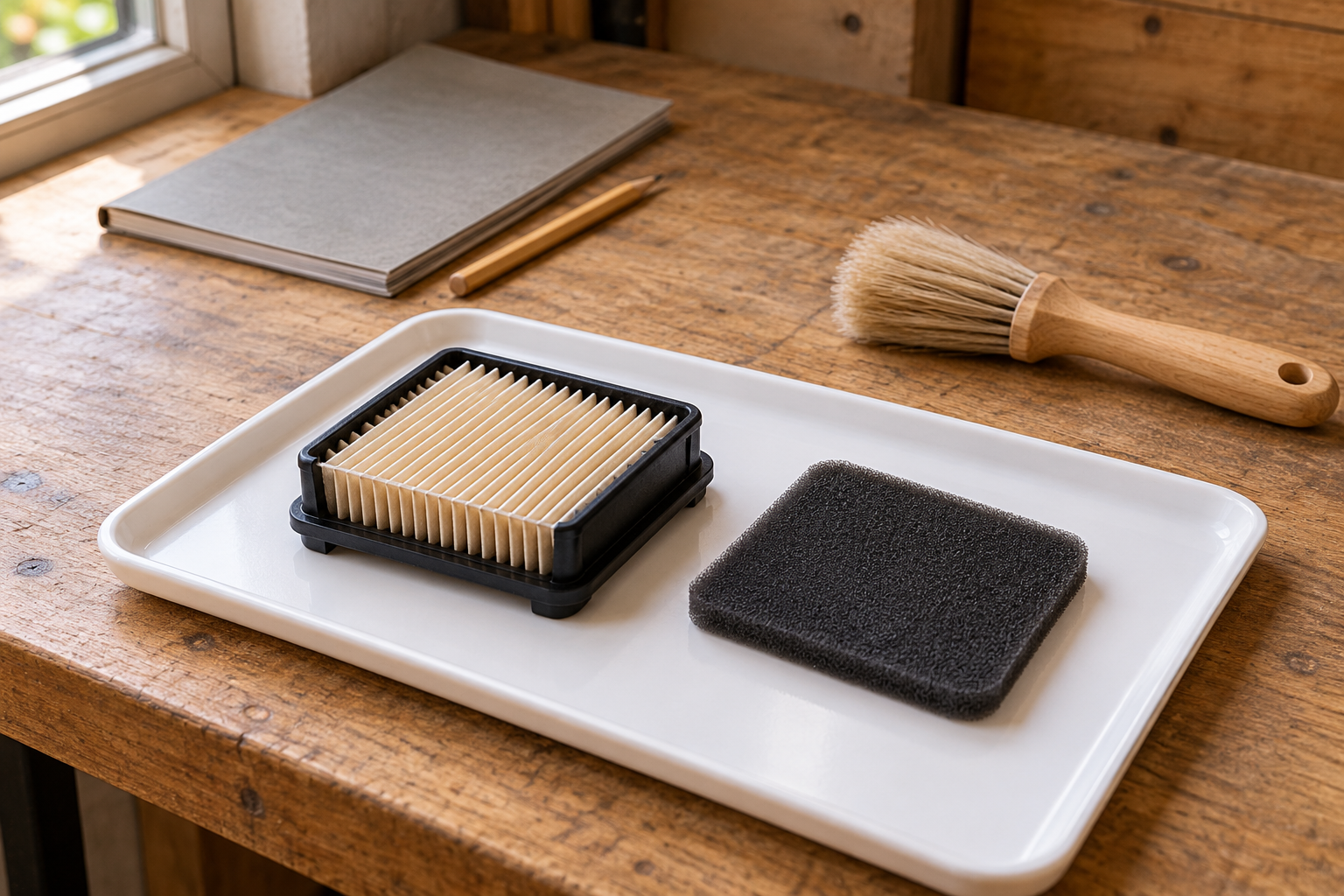
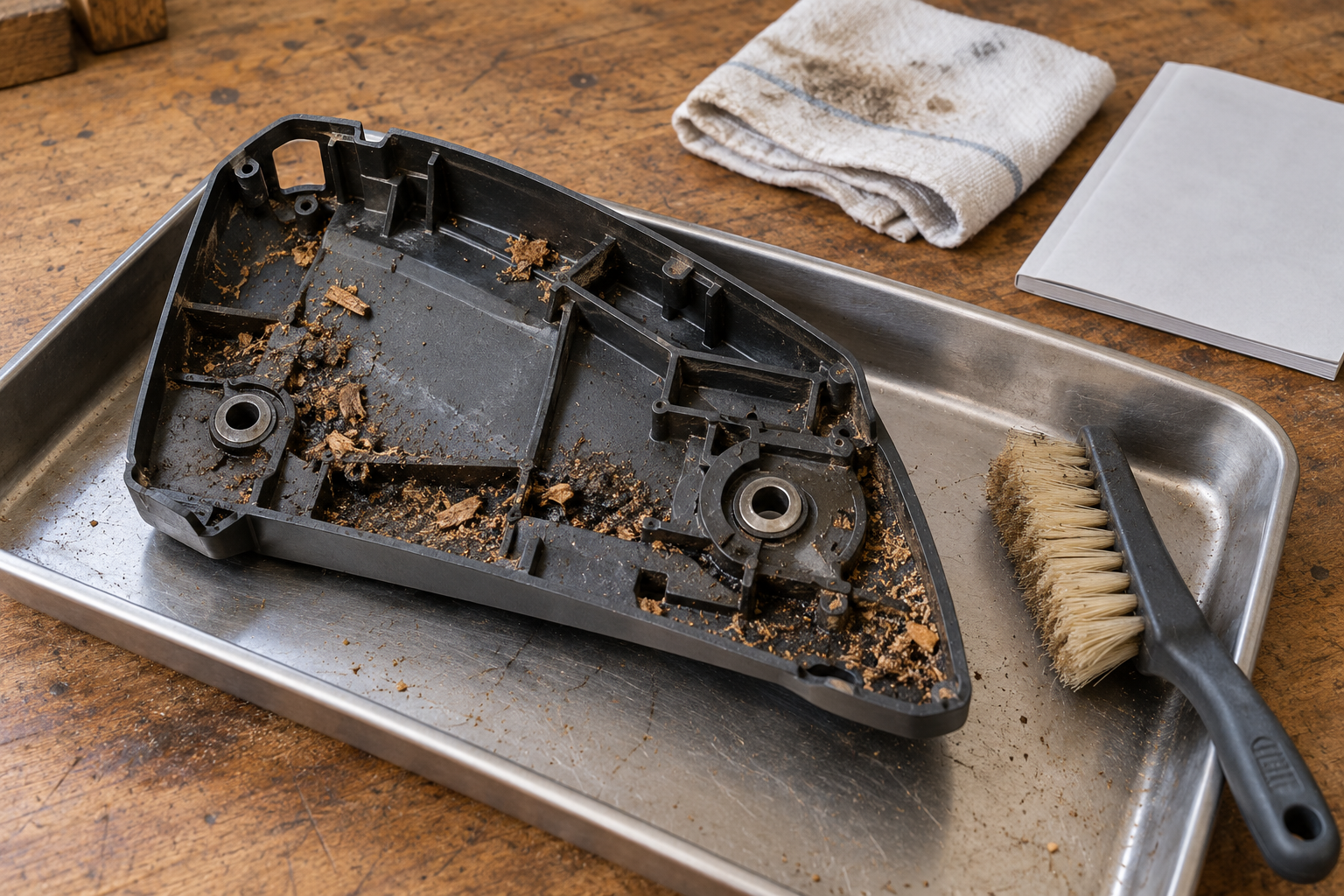
A chainsaw spark arrestor screen is a small mesh part in the muffler on some petrol saws; the exact manual decides whether your saw has one and whether its access is owner maintenance. Let the saw cool, confirm the model documentation, and stop at the manual or service route if the screen is not documented, cannot be identified, or is damaged.
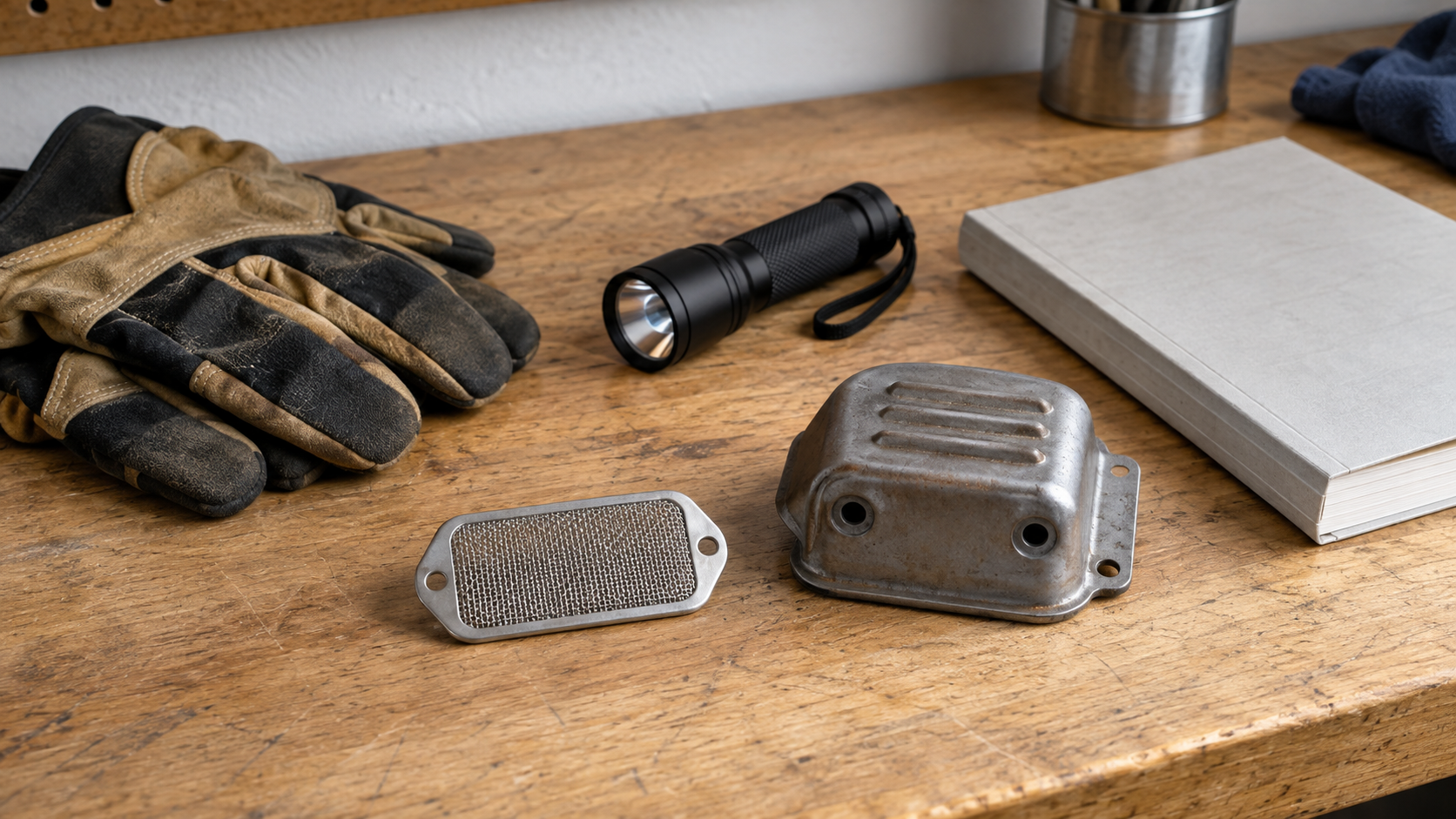
Illustrative parts still life only. It does not identify a screen, muffler cover, fastener, access route, or replacement part for any saw model.
Start with the model, not the muffler shape
The screen belongs to the exhaust system and is often described as being in the muffler. That does not mean every petrol chainsaw has the same part, placement, retaining hardware, or owner-service procedure. STIHL’s MS 150 C manual, for example, qualifies the screen as not present on every model or in every country. Husqvarna similarly limits its weekly-maintenance instruction to saws that are equipped with a screen.
Use the exact model and serial information to locate the operator manual, then look in the maintenance schedule and muffler/exhaust section. A parts photo, a similar saw, or an opening in a muffler cover is not enough to establish that a screen should be fitted.
Before looking at the exhaust area, switch the saw off and allow the muffler to cool completely. Alabama Cooperative Extension places the muffler among chainsaw components that require safety-aware maintenance. Keep the chain brake, fuel system, and cutting attachment out of this narrow decision: they are separate checks with their own manual instructions.
Use the present / absent / abnormal card
This card is a way to record the next safe action. It is not a removal or cleaning procedure.
| What the documentation or cool-saw observation establishes | What it means | Next action |
|---|---|---|
| The exact manual shows a spark arrestor screen and assigns its inspection or care to the owner | A screen is documented for this saw | Follow only that manual’s access, inspection, and reassembly instructions |
| The manual does not show a screen, or says the feature varies by market or model | The part is not established for this saw | Do not add a screen or borrow a part number from a similar saw; use the maker’s support or service route if exhaust work is needed |
| The documented screen is torn, holed, missing, heavily carbonized, loose, or cannot be safely identified | The exhaust-component result is unresolved | Keep the saw out of use and use the manual’s replacement/service direction rather than improvising a repair |
The card separates a confirmed component from a guess. It also avoids turning a maintenance check into an exhaust modification: do not remove, alter, bypass, or substitute the screen because a video, forum post, or generic parts listing appears to fit.
Keep access and reassembly inside the exact manual
Even a screen that looks accessible can sit behind a model-specific shroud, cover, or fastener sequence. The STIHL manual used for this article is an example of a manufacturer assigning a screen check to a particular model, not permission to transfer that method to another saw. A manual may also distinguish a screen that is merely checked from one that is cleaned, replaced, or handled by a dealer.
Read the surrounding warnings before starting any work the manual does assign. If the document does not show the component, calls for a dealer, or the part no longer matches its diagram after a cool-saw look, reassemble only if the manual says it is safe to do so and leave the rest to service. Do not use a wire brush, solvent, torch, compressed air, sealant, or a fabricated mesh based on a different saw’s instructions.
A screen is one branch of a running problem, not the diagnosis
Husqvarna lists a clogged screen as one possible contributor when a chainsaw starts and then dies. STIHL’s FAQ includes it among several checks, alongside fuel, fuel filtration, and the air filter. Those sources are useful precisely because they do not treat the screen as a universal answer.
If the saw stalls, loses power, smokes, or develops unusual heat, first preserve the pattern: when it occurs, whether it changes with saw position, and what the manual-permitted checks show. The starts-then-dies symptom guide keeps fuel, air, and position-related evidence separate from an exhaust observation.
Do not keep running the saw to compare its power, heat, or exhaust behaviour. A hot or smoking engine-area symptom needs a bounded cooling and airflow review, not a generic muffler repair; use the heat-location diagnostic to keep those routes distinct.
Record what a service provider can use
When the manual does not settle the question, record the full model and serial information, the manual page or wording you found, and the visible condition of the documented component after cool-down. Note the symptom that prompted the check without disassembling the muffler or changing any adjustment.
That record helps support identify the correct market-specific configuration and decide whether the saw needs a part, a specified owner-maintenance step, or a broader diagnosis. It is more reliable than choosing a screen by shape or assuming that a loss-of-power symptom proves an exhaust restriction.