A chainsaw decompression valve reduces peak cylinder pressure during starting, so the starter rope is easier to pull. Use it only if the exact petrol-saw manual shows that your model has one; it is a starting aid, not a choke, fuel pump, or repair control.
On the Husqvarna and STIHL examples cited below, the owner opens the control before a start attempt and it closes automatically after the engine fires. Designs differ, so the model manual—not the appearance of a nearby button—decides whether it applies and how it fits into the start sequence.
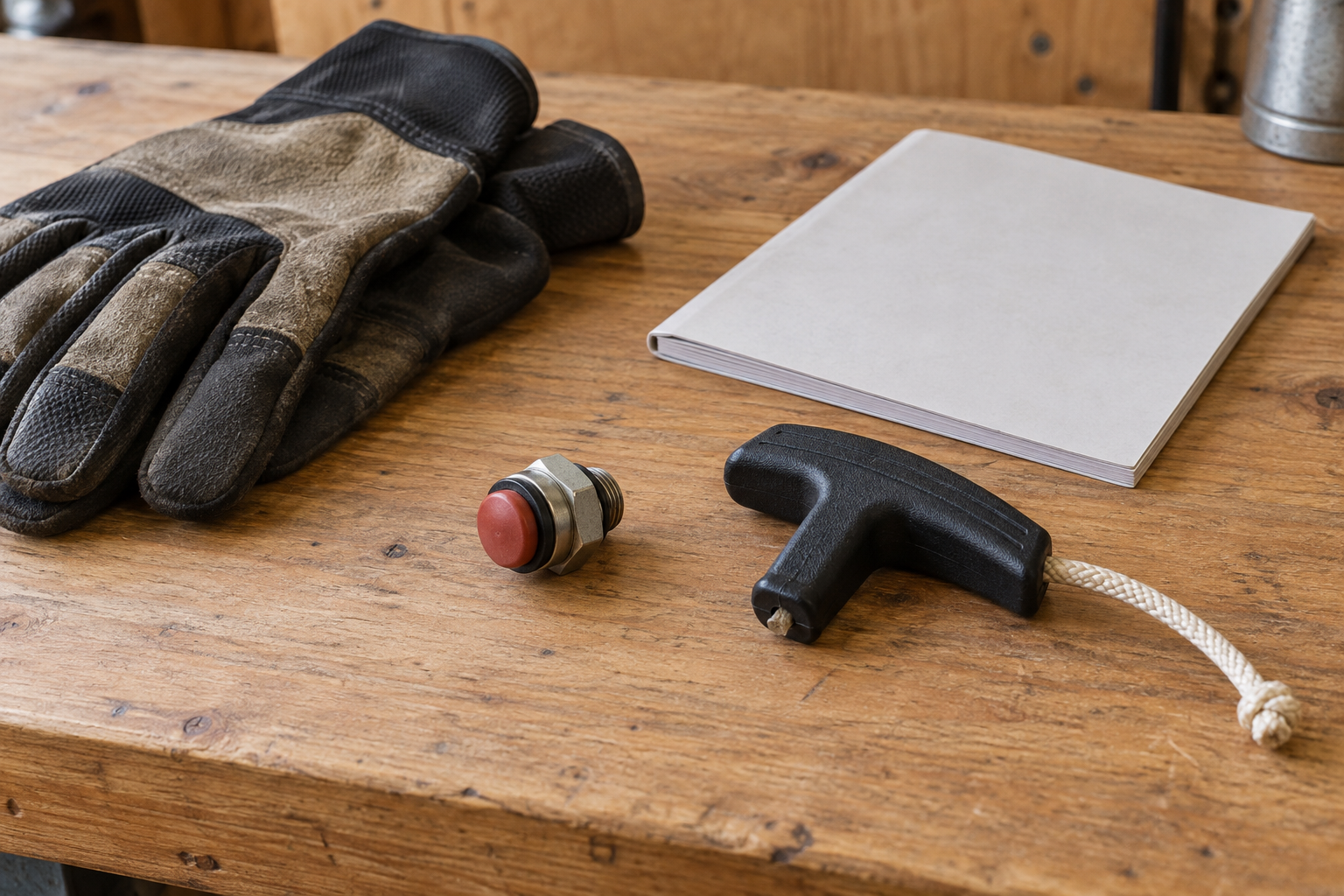
Illustrative starting-control still life only. The control shape, thread, colour, and location do not identify a chainsaw model or a replacement part.
It eases the pull; it does not start the saw by itself
During a petrol engine’s starting stroke, the piston compresses the fuel-air charge. A decompression valve releases part of that pressure for the start, which reduces the effort needed to turn the engine with the recoil rope. Husqvarna describes its manual valve as a user-operated control that resets after the engine starts. STIHL likewise describes a system that closes after firing on its current chainsaw designs.
That narrow job matters because several controls can sit near one another:
- A decompression valve reduces starting resistance on a model equipped with one.
- A choke or start-control setting belongs to the engine’s model-specific starting sequence.
- A manual fuel pump moves fuel through the starting system on models fitted with one.
- A chain brake is a safety control; the start procedure must still deal with it separately.
Do not identify a control by colour, position, or a photograph of another saw. Check the product overview and starting section of the exact manual. Some petrol saws have no decompression valve at all; STIHL notes that not every engine uses the feature.
Use the present / absent / abnormal card
Before attempting a start, place the saw on a stable surface and follow the manual’s isolation and starting instructions. STIHL’s published start guide calls for the chain brake to be engaged, the cutting attachment clear of the ground, and the saw held securely on the ground. Those safeguards remain necessary whether or not a decompression valve is fitted.
| What the model documentation establishes | What the reader can conclude | Next action |
|---|---|---|
| The manual identifies a decompression valve and includes it in the start sequence | The control is a starting aid for this saw | Follow the specified sequence; on the cited manual-valve examples, press the control before the applicable start attempt |
| The manual shows no decompression valve | The saw is not documented as using this particular aid | Do not add, press, or substitute a nearby control; use the published start sequence |
| The control is damaged, missing, stuck, behaves differently from the manual, or cannot be identified | The starting-control result is unresolved | Keep the saw out of service and use the maker’s model-specific service route |
This card is an editorial decision aid assembled from the cited manufacturer materials. It does not supply a universal button location, number of rope pulls, retrofit decision, or repair method.
Press it when the manual says to—often before each attempt
The STIHL MS 311/MS 391 manual provides a useful example of why a general answer has limits. It says to press the decompression button to open its valve, notes that the valve closes as soon as the engine fires, and therefore calls for the button to be pressed before each starting attempt. That is a model-specific instruction, not a sequence to transfer to every saw.
If your manual includes a decompression control, read its whole start sequence rather than treating the button as a standalone fix. The sequence can depend on whether the engine is cold or warm, what control system the saw uses, and whether it has a manual fuel pump. A rope that feels hard to pull may be normal starting resistance, but changed rope travel, a jam, or failure to retract is a separate starter-system question. Use the starter-rope symptom guide rather than forcing the handle or repeatedly pulling against a blockage.
Never drop-start a saw or hold it against your body while trying to see whether a decompression control helps. Start only in the position and with the control order specified for the model.
Keep an abnormal valve separate from a broad no-start diagnosis
A decompression valve does not prove why a saw is hard to start, fails to fire, lacks power, or stalls. Fuel condition, starting settings, ignition, air flow, engine condition, and other model-specific causes remain separate questions. Repeatedly operating one control is not a valid way to rule those out.
Stop at the manual or a qualified service provider if the valve will not move as described, remains in an unexpected position, is visibly damaged, or the starting behaviour changes without a clear documented explanation. Do not pry, force, lubricate, remove, plug, clean with compressed air, or retrofit the valve based on a generic tutorial. The part’s construction, service limit, and access route belong to the exact engine and saw model.
Likewise, do not mistake a decompression-control question for a chain-brake problem. The brake is a separate safety system with its own inspection boundary; the manual-first chain-brake check explains how to keep that assessment within model-specific instructions.
Record the useful details before asking for service
If the manual does not resolve the question, record the saw’s full model and serial or production information, the wording or diagram that identifies the control, its visible condition, and what it does during the documented start sequence. Note whether the starter rope itself moves and returns normally, but do not disassemble the starter or engine to collect more evidence.
That record helps a dealer or manufacturer support route distinguish an unfamiliar control from an abnormal one. It is safer and more useful than guessing from a similar petrol saw or ordering a part by shape alone.