A chainsaw chain catcher that is loose, cracked, bent, missing, or damaged after a derailment should be replaced before the saw is used again. It is a safety device intended to help stop a thrown or derailed chain from reaching the operator; it is not proof that the chain, bar, sprocket, or cover escaped damage.
This is a narrow inspection guide for a homeowner who has found a suspect catcher. It does not identify a replacement part by appearance or authorize disassembly beyond the procedure in the operator’s manual for the exact saw.
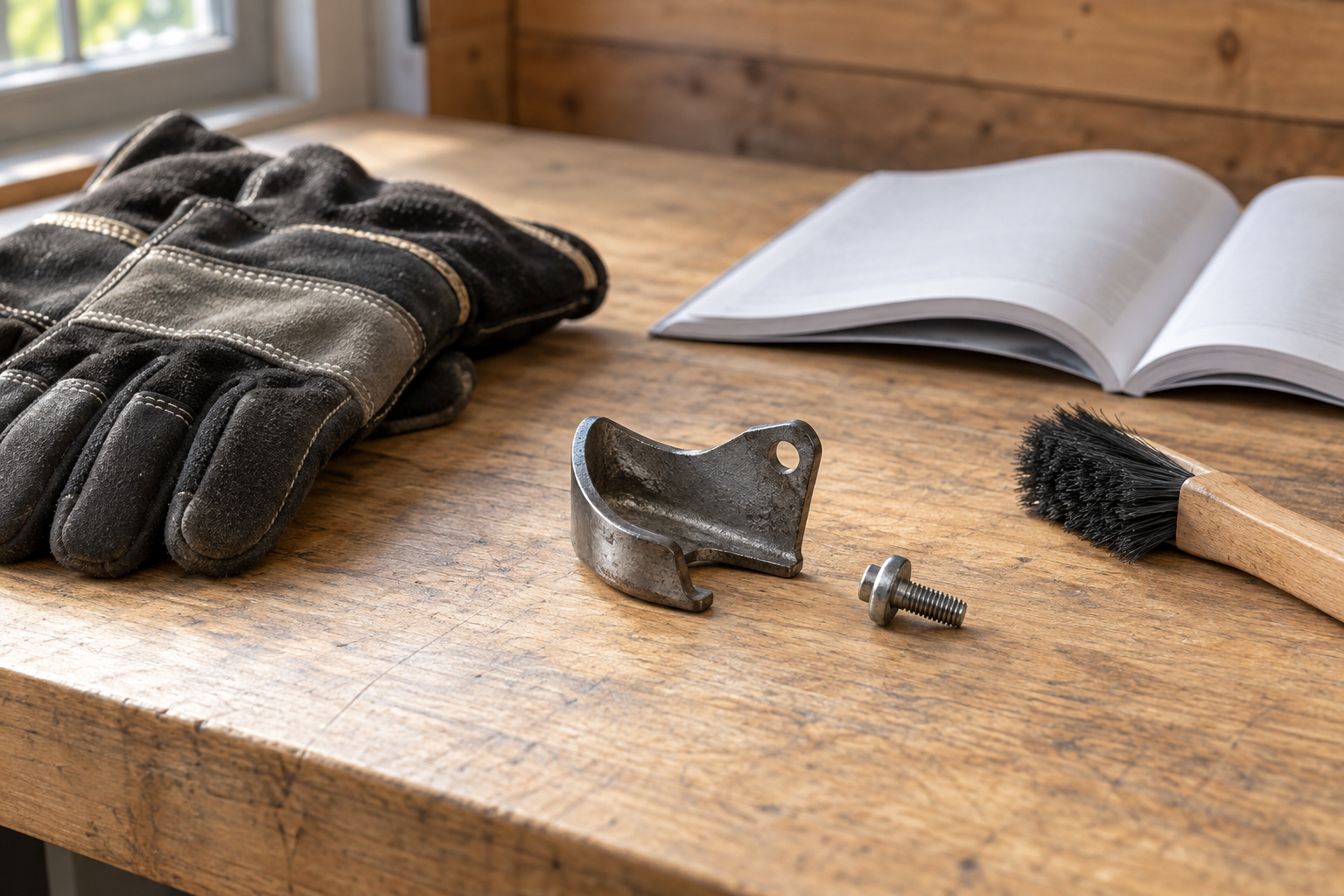
Illustrative service-preparation scene; the pictured parts are not a fit guide or a substitute for the saw’s parts information.
First, identify the part without treating it as a diagnosis
The chain catcher sits at the saw body near the cutting attachment and is meant to help contain a chain that comes off the guide bar or breaks. Husqvarna describes two broad designs: a plastic catcher formed as part of the case, and an aluminium catcher fixed with a small bolt. Those descriptions help explain why two saws can look different; they do not make the parts interchangeable.
Power the saw down and make it unable to start by the method in its own manual. Let the cutting attachment cool and wear gloves before handling the chain. Do not start the saw merely to see whether a damaged catcher will “hold.”
Use the catcher evidence card before buying a part or refitting a chain:
| What you can see with the saw off | Decision | What remains to check |
|---|---|---|
| Catcher is present, intact and secure | Continue the normal pre-use inspection | Chain condition and seating, cold tension, bar, cover and the saw’s other safety controls |
| Catcher is loose, cracked, bent, missing or displaced | Keep the saw out of service; obtain the exact manual’s replacement part and procedure | The mounting area and the rest of the cutting system, especially after a derailment |
| Catcher was struck during a derailment or chain failure | Do not treat the catcher as the only damaged item | Chain, guide-bar rails and nose, sprocket, cover, mounting faces and correct component match |
This card is an editorial sorting tool built from the manufacturer instructions, not a force test. A catcher can look present while its attachment or surrounding saw body needs the model-specific procedure.
Why a replacement does not close the derailment question
Husqvarna’s thrown-chain guidance directs the owner to check the chain type and size for the bar and drive sprocket, the bar-nose sprocket, chain and bar cleanliness, tension, and catcher damage. That order matters. Replacing only the visible catcher can leave the event that damaged it unresolved.
Work through the evidence with the power isolated:
- Read the chain first. Look for broken, bent, cracked, missing, or badly damaged links and rivets. A damaged loop is not made serviceable by a new catcher.
- Read the path next. Inspect the guide-bar groove and rails, the nose if fitted, the drive sprocket, and the cover only as the manual permits. If the chain has repeatedly left the bar, use the chain-keeps-coming-loose diagnostic to separate tension, fit, bar and sprocket evidence.
- Read the catcher and its mounting area. Dirt can hide a crack or a loose fastener. Clean only as the maker permits, then determine whether the catcher itself, the attachment point, or an adjacent cover piece is damaged.
- Match before fastening. Use the saw’s operator’s manual or official parts support to identify the part for that model. Do not substitute a catcher because its material, colour, or bolt position looks similar.
If the cause of a derailment is unclear, a catcher replacement is not a release decision. Keep the saw out of service until the chain and guide system can be checked by the relevant instructions or a qualified service provider.
Replace only by the exact saw’s procedure
For its own machines, Husqvarna’s example procedure removes the clutch cover, removes the damaged catcher, fits the new catcher and refits the cover. The same page says to consult the operator’s manual for the correct catcher type. Other designs may be formed into the case or may have different access and fastening requirements.
That creates two useful boundaries:
- Do not transfer a screw location, fastener method, or replacement part from a support page to a different model.
- Do not operate without the catcher while waiting for a part. Husqvarna explicitly cautions against using a chainsaw without one.
If the manual does not clearly show the part or the mounting area is cracked, stripped, or uncertain, stop at identification. A dealer or qualified service provider can determine whether the repair is limited to the catcher or involves the cover or saw body.
Release the saw only after the whole pre-use check
An intact catcher is one item in a safety inspection, not a standalone approval. Husqvarna’s safety-inspection material pairs it with checks of the chain brake, throttle controls, stop switch, fasteners and other safety features; it says to seek dealer help when safety features are in doubt.
After the correct catcher is installed by the applicable procedure, return to the chain-maintenance inspection sequence. Confirm the chain is serviceable and seated correctly, follow the model’s cold-tension procedure, and complete its safety-control checks before cutting.
Keep the saw out of service when any one of these remains true:
- the catcher is damaged, absent, loose, or not positively identified for the saw;
- the attachment point, cover, or nearby saw body is cracked, stripped, or otherwise suspect;
- a chain or guide-system part was damaged in the same derailment;
- the chain repeatedly derails or will not pass the manual’s fitting and movement checks; or
- the model manual or parts identification is unavailable and the correct repair cannot be confirmed.
Record the saw model, where the catcher is damaged, and whether a derailment or chain failure occurred. That concise note gives the manual, dealer, or service provider the facts needed to decide the next repair without guessing from a generic photograph.