Take a retired lithium-ion chainsaw battery to a battery recycler, participating takeback service or household hazardous waste program that confirms it accepts your pack; keep it out of household trash and curbside recycling. If the pack is damaged, defective or recalled, contact its manufacturer for handling and disposal instructions before preparing it for an ordinary drop-off.
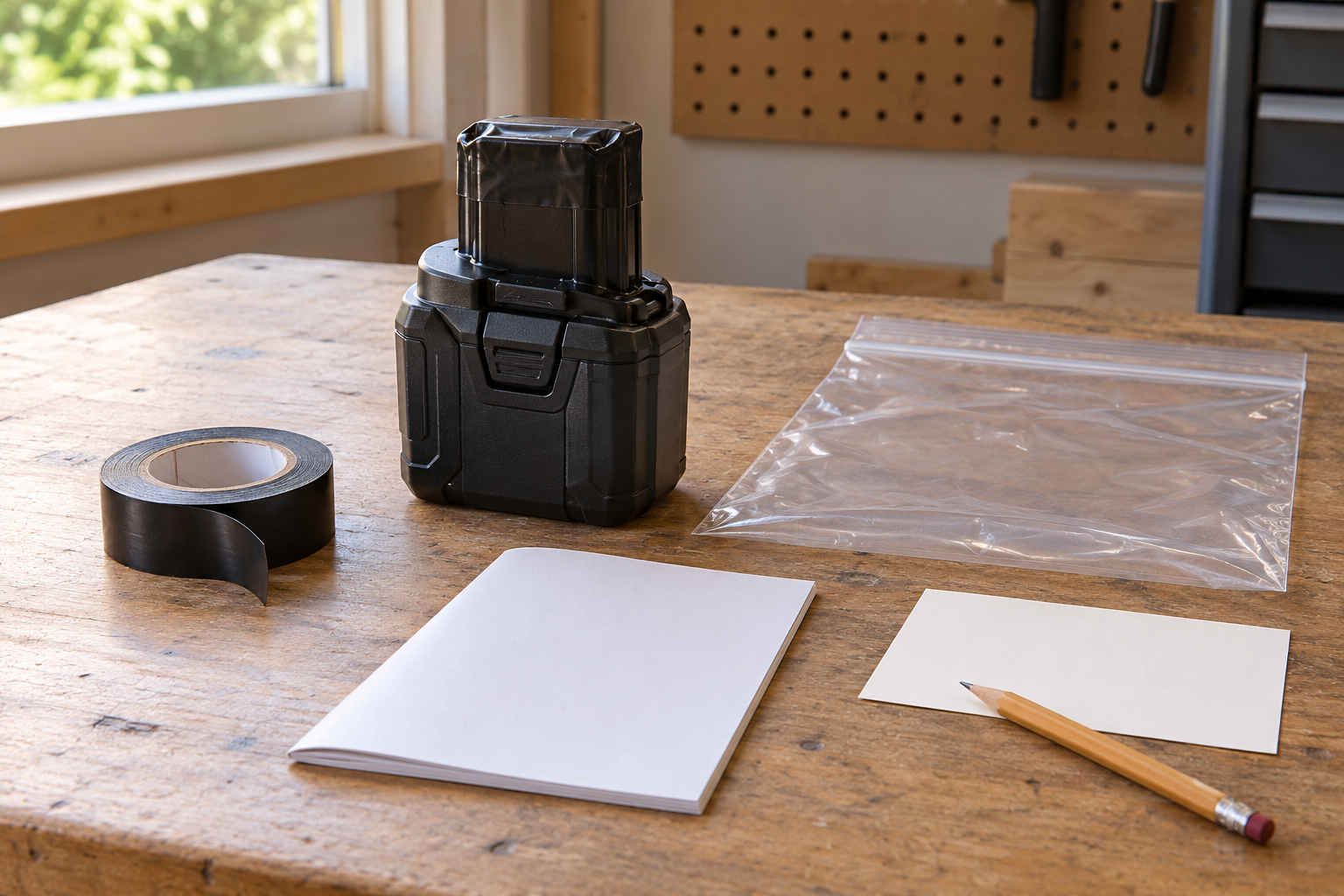
This guide is for US household owners arranging an end-of-life handoff. It covers removable packs, with a separate route when the battery cannot be removed by the user. The photograph illustrates preparation of an intact pack; it is not a packaging example for a damaged battery or a shipment.
Identify what you are handing over
Read the battery label and its instructions. Record the manufacturer, battery model and chemistry, plus any capacity or energy information printed on the label. EPA identifies labels, manuals and product markings as ways to establish lithium-ion chemistry. Do not identify a pack from its casing colour or from the chainsaw brand alone.
Keep the battery model separate from the saw model. The person arranging collection needs to know which pack you have, rather than only that it came from a cordless chainsaw. If a marking is unreadable, make that an unresolved item in your enquiry; do not replace it with a specification found for a similar-looking pack.
Follow the equipment instructions for user-removable batteries. EPA warns that not every battery is user-removable or serviceable. If those instructions do not cover removal, ask about acceptance of the complete device.
An unresolved charging complaint is a different job from an agreed disposal decision. The battery-not-charging guide helps record a permitted external check and the exact fault indication. Do not perform another charging attempt merely to complete a recycling enquiry, especially when damage or a manual stop condition is present.
Damage changes the route
The Battery Network lists swelling, leakage, puncture and overheating among damaged or defective battery conditions. Its warning signs also include cracked or warped casings, burn marks and water damage. A recall needs its own check against the manufacturer’s model and identifying information; a normal-looking casing does not settle that question.
Describe known damage or abnormal behaviour when contacting the manufacturer. Avoid reducing the description to “used battery.” For example, a report of a cracked casing gives the recipient information that a request to recycle an old pack leaves out.
Damaged and defective packs do not belong in The Battery Network’s ordinary collection boxes. Its current guidance directs owners to the manufacturer for management, shipping, recycling or disposal instructions, and assigns recalled batteries to the manufacturer’s instructions. Do not treat ordinary terminal tape, an individual bag or an intact-pack collection listing as approval for this route.
Ask for instructions before moving or packaging a suspect pack. This page does not provide a containment method, a repair procedure or an emergency-response plan. If the condition is uncertain, leave the ordinary drop-off preparation unfinished until the manufacturer tells you how to proceed.
Confirm the receiver before making the trip
For an intact retired pack, begin with a specialist battery recycler, a participating retailer or your local household hazardous waste program. EPA names these as consumer collection routes. A recycling symbol on the pack does not mean it belongs in the bin collected with paper, glass and household packaging.
Use the current battery drop-off locator to look for a suitable category and location. The interface distinguishes rechargeable batteries from high-energy batteries and warns that acceptance varies by battery type and state. Choose the category from the pack information and program instructions, rather than assuming every chainsaw battery belongs in the same group.
The Battery Network has a dedicated high-energy outdoor-power battery program with participating-brand and trained-site requirements. That is a reason to check the actual pack and destination; it is not a rule that every cordless chainsaw pack requires that program.
Contact the proposed receiving location with your details. Ask whether it currently accepts that battery type, brand and condition, and what preparation and arrival instructions apply. A map pin is a lead for this confirmation. Do not report it as a verified acceptance decision before the site has answered.
Use this acceptance record
Keep one record for each different pack or condition. This is a planning aid for the handoff, not a battery test or evidence that a pack is safe.
- Pack identity: manufacturer, battery model, chemistry and printed capacity or energy information.
- Condition disclosed: intact retired pack, known damage, suspected defect, recall, or uncertainty requiring advice.
- Receiving route: named collection location or manufacturer contact, and the date of its response.
- Acceptance confirmed: the exact pack/category and condition the receiver agreed to take; note any unresolved question.
- Preparation and arrival: the receiver’s instructions, including whether an appointment or a different collection arrangement is required.
- Next action: ready for the agreed handoff, awaiting instructions, or referred elsewhere.
For example, “location found; condition acceptance unanswered” is an incomplete arrangement. It should remain incomplete on the record. That small distinction prevents a locator result from becoming an assumption about damaged-pack acceptance or a particular brand’s participation.
Prepare only the pack covered by those instructions
For ordinary intact lithium-ion batteries, EPA recommends protecting the terminals with nonconductive tape, such as electrical tape, or isolating each battery in its own plastic bag. Follow the pack warnings and the receiving program’s instructions. These precautions address contact between terminals and other batteries or metal; they do not prove that a damaged pack is suitable for routine collection.
A pack that no longer powers the saw can still retain energy. Do not open it, attempt a repair or expose its cells to make it fit a collection category. Keep the identifying information available to the receiver rather than relying on the appearance of the prepared pack.
A drop-off arrangement does not authorize mailing. EPA notes that shipped batteries need appropriate identification, packaging and labelling. Obtain specific shipping instructions from the manufacturer or receiving program.
If the receiver declines the pack, ask the manufacturer or local household hazardous waste program for the next route and update the acceptance record. Leave it marked “awaiting instructions” until a receiving arrangement is confirmed. For equipment that remains usable, return separately to the chainsaw storage checklist and its model-specific care requirements.