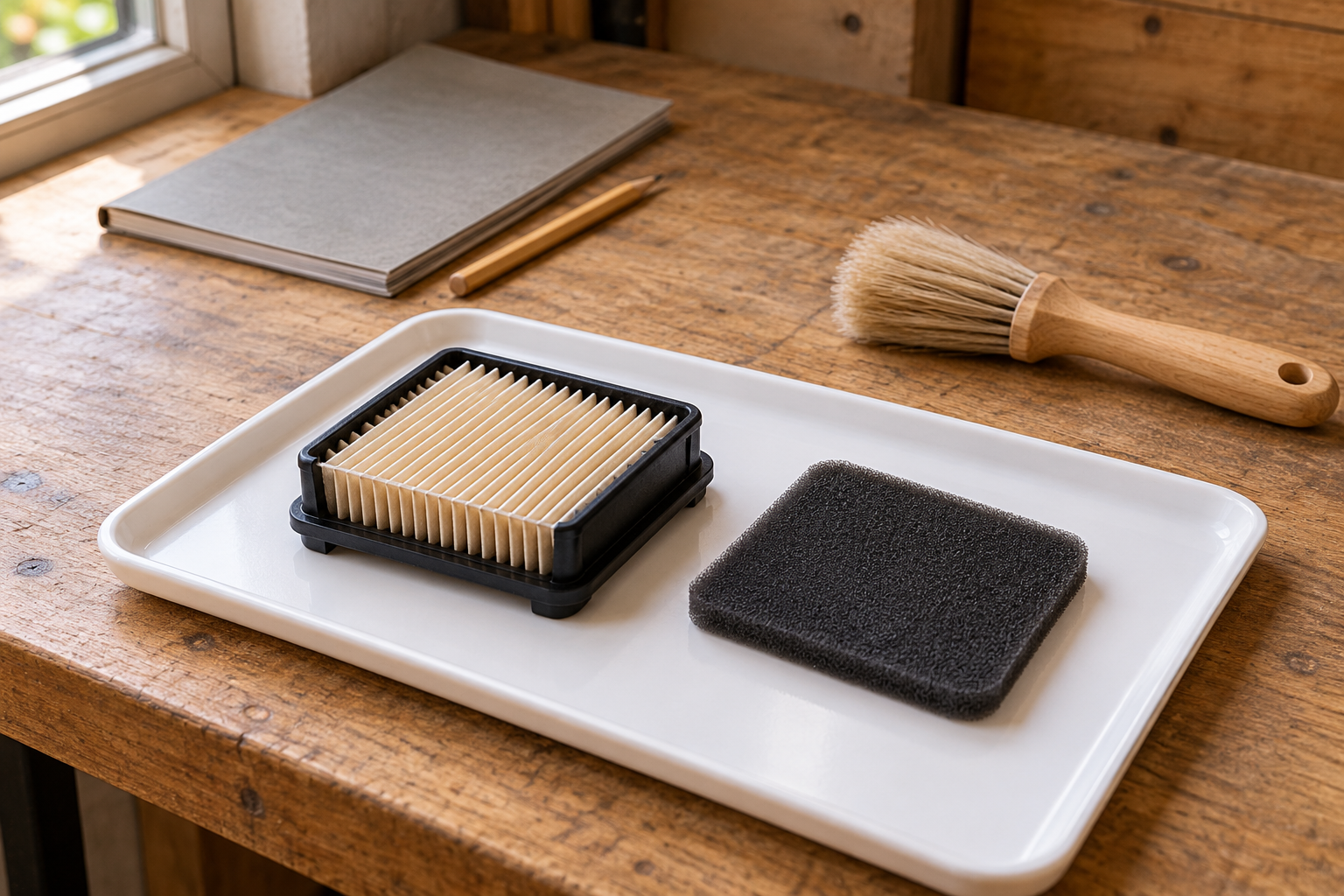
Replace a chainsaw fuel filter only when the exact operator manual shows that filter and you have the correct replacement part. Before you start, keep the saw cool and off, deal with fuel as the manual requires, and stop if the line is cracked, brittle, loose, or not clearly documented.
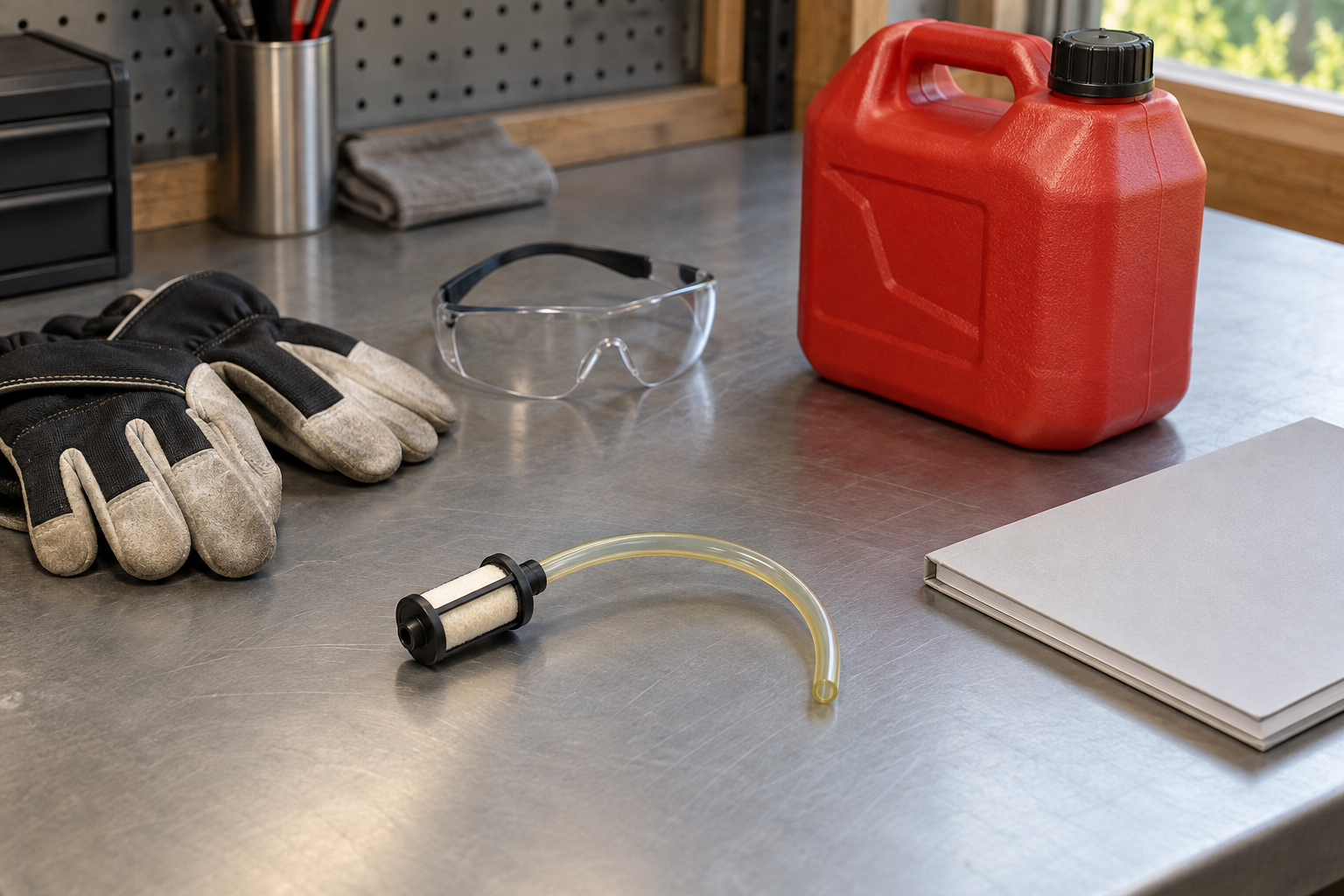
Illustrative parts still life only. It does not identify a filter, hose, cap-retainer design, replacement part, or service procedure for any chainsaw model.
First, establish that it is a fuel-filter job
On many petrol chainsaws, the fuel filter sits inside the tank at the end of a flexible fuel line. That common layout is not a parts-identification rule. The filter shape, connection, line routing, cap-retainer arrangement, and owner-maintenance permission can differ between models.
Find the exact model’s operator manual and parts information before buying or removing anything. Confirm all three points:
- the manual or parts list shows an in-tank fuel filter;
- the manufacturer identifies the replacement part or a valid part-number route; and
- the manual assigns access and refitting to the owner rather than a dealer.
Husqvarna’s current fuel-filter procedure makes the same distinction: it tells the owner to consult the operator’s manual for the correct filter type. A filter that resembles the old one, a video for another saw, or an online listing with a familiar brand name does not establish fit.
This page is not a diagnosis of every hard-start, no-start, or stalling complaint. A filter can be one cause of restricted fuel delivery, but it cannot prove that the carburettor, ignition system, air path, tank vent, fuel quality, or engine condition is sound.
Use the filter / line / symptom routing card
Make this decision with the engine off and cool. Follow the manual’s fuel-handling, isolation, and work-area requirements; OSHA also directs operators to follow manufacturer maintenance instructions and keep fuel away from ignition sources.
| What the manual and cool-saw observation establish | What that means | Next action |
|---|---|---|
| The exact manual shows an in-tank fuel filter, names or routes to the correct part, and assigns replacement to the owner | The part and task are documented for this saw | Follow the model’s complete empty-tank, access, fitment, and refitting instructions |
| The filter is documented, but the line is cracked, brittle, swollen, loose, kinked, or does not match the diagram | The task is no longer just a filter replacement | Do not cut, splice, stretch, seal, or substitute the line; use the model’s parts and service route |
| The manual does not show the filter, the part cannot be matched, or the fuel-delivery symptom remains after the documented work | The cause or component is unresolved | Stop at manufacturer support or qualified service rather than repeating starts or changing other fuel-system parts |
The card is a record of a safe next action, not a universal installation guide. It avoids a frequent mistake: treating every small part in the tank as a fuel filter, then using a generic procedure to make it fit.
Empty the tank only by the applicable instructions
Fuel changes the boundaries of this maintenance task. Husqvarna’s procedure calls for an empty fuel tank and no smoking before a filter change. The exact way to empty a tank, handle remaining fuel, ventilate the work area, and secure the cap belongs to the saw’s manual and applicable local requirements.
Do not drain fuel into an unapproved container, work near a flame, smoke, run the engine solely to empty a tank, or use a spill as a reason to hurry the reassembly. If fuel has leaked, a cap seal is damaged, or the manual’s fuel-handling instructions are not available, pause the task and use a service or disposal route appropriate to your location.
The chain is still sharp while stationary. Keep the saw in the stable position specified by its manual, use appropriate hand protection for handling the cutting attachment, and avoid turning a filter job into an unrelated adjustment. The bar, chain, brake, carburettor settings, and exhaust system each have their own inspection path.
Keep the replacement matched to the saw, not the symptom
Once documentation confirms the part, use the maker’s stated part number or its official parts lookup. The Draper manual read for this article is one manufacturer example that specifies a genuine replacement filter. That is not evidence that every chainsaw uses the same filter, interval, connection force, or retaining arrangement.
Before placing the documented new filter back in the tank, compare only what the manual allows you to verify: the listed part, its intended line connection, and the line’s condition. Do not make a hose fit by cutting it, warming it, adding sealant, using wire as a clamp, or borrowing a filter from a different engine. A line that has aged, cracked, or changed shape needs a model-specific parts decision, not a filter-only workaround.
Husqvarna’s fuel-delivery support page is useful here because it keeps the two observations separate: it identifies the filter as a fuel-flow component but also tells owners to check a line for cracks or age-related brittleness. If either condition is uncertain, record it and stop before refilling.
Do not use replacement as a running test
After the manual-approved work is complete, follow that manual’s check for cap installation, fuel fill, starting, and leak observation. Do not start the saw to see whether a guessed filter, line repair, or unknown fuel arrangement is “close enough.” Do not defeat a safety control, adjust the carburettor, remove the muffler, or repeatedly pull the starter rope to force a conclusion.
If the original complaint was a saw that fires and then stops, the filter is only one possible branch. Use the starts-then-dies diagnostic to preserve the timing, position, idle, fuel, and airflow evidence rather than replacing several parts at once. A persistent symptom after a documented filter replacement is information for manufacturer support or a service provider, not proof that another component should be changed.
If the manual calls for fresh premixed fuel after the work, confirm the ratio, oil specification, and fuel identity before filling. The fuel-mix calculation guide covers that separate preparation task; it cannot make an unknown old batch safe or establish a filter’s compatibility.
Give service the details it needs
When a manual does not settle the replacement or the symptom continues, record the full saw model and serial or production number, the manual page or parts-diagram reference, the observed line condition, and the exact fuel-delivery symptom. Note whether the fuel filter is shown in the documentation and whether fuel or a leak was present—without dismantling further components to chase an answer.
That record helps support distinguish a documented owner-maintenance item from a damaged line, a missing part, a tank issue, or a broader engine complaint. It is more useful than a replacement chosen by shape, and it keeps the next step tied to the machine that actually needs service.